What Is a Data Science Certification
A data science certification validates skills in analytics, machine learning, and data handling, helping professionals improve career opportunities.
A few years ago, if someone said they were learning data science, people reacted like they had just announced they were building robots in their basement.
Now?
Everybody suddenly wants to learn it.
Students want it.
Working professionals want it.
Managers want it.
Even people who once said, “I hate numbers,” are now searching for the best data science certification at 2 AM while questioning every life decision they ever made.
That is how fast the tech world changed.
Today, companies are obsessed with data. Every click, scroll, purchase, swipe, search, and online action creates information. Businesses are collecting mountains of data every second, and somewhere inside all that chaos are insights capable of making companies richer, smarter, and faster.
The problem?
Most companies have tons of data but not enough skilled people who know what to do with it.
That is exactly why data science certifications became so valuable.
And honestly, this industry is growing so fast that even job titles now sound like superhero names.
Machine Learning Expert.
MLOps Engineer.
Certified Data Engineer.
Data Scientist in Finance.
It genuinely feels like the technology industry stopped naming jobs normally.
So, What Exactly Is a Data Science Certification?
A data science certification is a professional credential that proves a person understands how to collect, analyze, interpret, and use data to solve real-world problems.
In simpler words:
It tells employers,
“Yes, this person knows how to work with data without accidentally breaking everything.”
These certifications usually validate skills in:
- Python
- SQL
- Machine learning
- Data visualization
- Predictive analytics
- Statistics
- Artificial intelligence
- Business analytics
Many certification programs also include practical projects because companies do not just want people who watched tutorials for six months while saying “I’ll start tomorrow.”
They want professionals who can actually solve problems.
Why Is Everyone Suddenly Talking About Data Science?
Because data became the new business currency.
Companies today use data to:
- Predict customer behavior
- Detect fraud
- Improve marketing campaigns
- Automate decisions
- Reduce operational costs
- Improve healthcare systems
- Forecast financial risks
Basically, businesses now rely on data the same way people rely on Wi-Fi.
The moment it stops working, panic begins immediately.
According to industry reports, professionals with recognized data science certifications can earn significantly higher salaries compared to non-certified candidates. Some reports even suggest salary increases reaching up to 40% after advanced certification and skill development.
That number alone is enough to make people suddenly “passionate about analytics.”
The Foundations of Data Science Matter More Than People Think
Most beginners imagine data science looks like this:
Open laptop → type magical code → artificial intelligence appears.
Reality looks slightly different.
Usually it starts with confusion.
Then more confusion.
Then statistics enters the conversation and everyone becomes emotionally unstable for a few days.
The foundations of data science are extremely important because advanced machine learning makes no sense without understanding the basics first.
Strong certification programs teach:
- Data collection
- Data cleaning
- Statistical analysis
- Probability
- Data interpretation
- Exploratory analysis
And yes, data cleaning is a real thing.
A shocking amount of data science involves fixing messy datasets created by humans who apparently enjoy typing random information into spreadsheets.
Why Python Became the Favorite Child of Data Science
If programming languages were celebrities, Python would currently be the one getting followed everywhere.
Python dominates data science because it is powerful, flexible, and relatively beginner-friendly.
Most certification programs teach Python libraries like:
- Pandas
- NumPy
- Matplotlib
- Scikit-learn
These tools help professionals analyze huge datasets efficiently.
Many courses also focus on data science for developers, helping software engineers transition into AI and analytics careers.
And the transition usually begins confidently.
Then someone encounters machine learning math.
Then suddenly motivational quotes become very important.
Machine Learning Experts Are in Massive Demand
One of the biggest reasons people pursue certifications is to become a machine learning expert.
Machine learning allows systems to learn patterns automatically from data.
This technology powers:
- Recommendation systems
- Fraud detection
- Voice assistants
- AI chatbots
- Smart automation
- Predictive analytics
Without machine learning, modern technology would feel dramatically less intelligent.
Your streaming app would stop recommending shows.
Your shopping apps would stop predicting what you want.
And social media algorithms would probably stop reading minds so aggressively.
Certification programs often teach:
- Regression models
- Classification algorithms
- Clustering techniques
- Neural networks
- Deep learning
At first, these terms sound terrifying.
Eventually they become normal.
Then one day you casually say words like “random forest optimization” during conversations and confuse everyone around you.
That is character development.
What Does a Certified Data Scientist Actually Do?
A certified data scientist solves business problems using data.
Simple explanation.
Very complicated job.
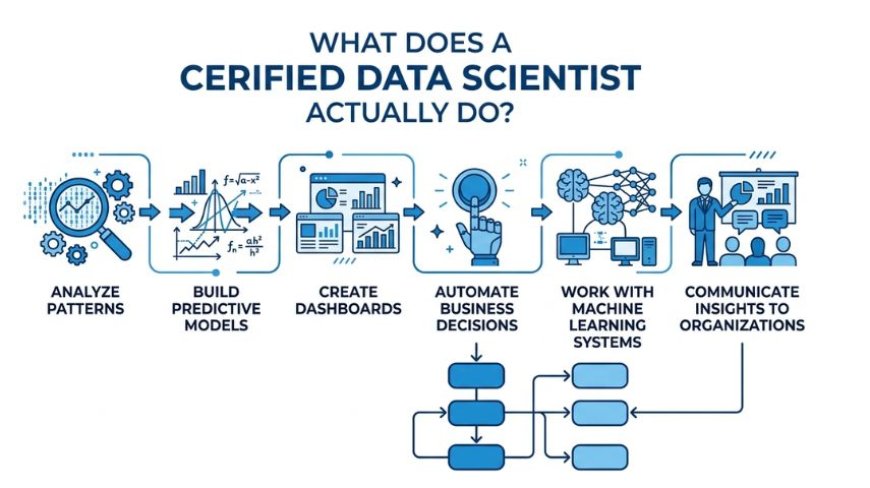
These professionals:
- Analyze patterns
- Build predictive models
- Create dashboards
- Automate business decisions
- Work with machine learning systems
- Communicate insights to organizations
And surprisingly, communication skills matter a lot.
Because building a brilliant AI model means nothing if nobody understands the results.
Sometimes the hardest part of data science is explaining technical findings to non-technical teams without watching their souls leave their bodies during presentations.
The Rise of the Data Scientist in Finance
The role of a data scientist in finance has become extremely important.
Banks and financial companies now use AI for:
- Fraud detection
- Risk management
- Investment forecasting
- Credit scoring
- Customer analytics
Imagine millions of digital transactions happening every minute.
Humans alone cannot monitor everything.
That is why machine learning systems became essential in modern finance.
And honestly, if an AI system can detect suspicious activity faster than humans, that is impressive because some people still cannot detect fake messages promising “Congratulations! You won a luxury car.”
Data Science in HR Is Quietly Taking Over
A lot of people are shocked when they hear about data science in HR.
But HR analytics has become huge.
Companies now use data science to:
- Improve hiring decisions
- Predict employee turnover
- Analyze workplace performance
- Optimize recruitment strategies
Modern recruitment is becoming increasingly data-driven.
Some systems can analyze hiring trends faster than managers who still say things like “Let us circle back next quarter.”
Corporate vocabulary alone deserves scientific research at this point.
Why Marketing Teams Love Data Scientists
A data scientist in marketing helps businesses understand customer behavior.
These professionals analyze:
- Campaign performance
- Customer engagement
- Purchase patterns
- Audience preferences
- Conversion rates
Marketing teams use data science to personalize advertisements and improve targeting.
That explains why online platforms somehow know exactly what people searched for five minutes ago.
Technology today remembers everything.
Meanwhile humans walk into rooms and immediately forget why they entered.
Why Managers Are Learning Data Science Too
Interestingly, many learners are not aiming to become full-time programmers.
A growing number of executives now study data science for managers to improve decision-making skills.
Managers today must understand:
- Business analytics
- AI-driven insights
- Performance dashboards
- Predictive reporting
Because modern companies rely heavily on data-based decisions.
The era of “I just feel this strategy might work” is disappearing quickly.
Now companies want charts.
Metrics.
Forecasts.
Dashboards.
And approximately 47 PowerPoint slides explaining everything.
The Role of a Certified Data Engineer
Data scientists need clean, organized, and accessible data.
That responsibility belongs to the certified data engineer.
Data engineers build systems that:
- Store information
- Process datasets
- Manage data pipelines
- Support analytics infrastructure
Without data engineers, many AI systems would collapse immediately.
Because machine learning models cannot magically function with broken or incomplete data.
Well technically they can.
But the results become terrifying.
Why the MLOps Engineer Role Is Exploding
One of the hottest careers today is becoming an mlops engineer.
MLOps combines machine learning with operational deployment systems.
These professionals help companies:
- Deploy AI models
- Monitor performance
- Automate workflows
- Maintain production systems
Building an AI model is one challenge.
Keeping it running successfully in real business environments is another level entirely.
Many companies discovered this the hard way after creating impressive AI demos that immediately stopped functioning once actual users appeared.
Production environments are basically reality checks for technology teams.
How to Choose the Best Data Science Certification
Choosing the best data science certification depends on career goals.
Beginners may need foundational programs.
Developers may want advanced machine learning specializations.
Managers may focus on business analytics certifications.
A good certification should include:
- Industry Recognition: Employers should recognize the credential.
- Hands-On Projects: Practical experience matters enormously.
- Updated Curriculum: Technology changes constantly.
- Career Support: Mentorship and guidance are extremely valuable.
- Real-World Applications: Theory alone is not enough anymore.
Because companies hire problem-solvers, not human search engines repeating textbook definitions.
Data Science Consulting Services Are Growing Fast
Another rapidly growing industry is data science consulting services.
Many businesses want AI solutions but lack internal expertise.
So consultants help organizations:
- Build predictive models
- Improve business analytics
- Automate workflows
- Develop AI strategies
Companies across healthcare, retail, finance, and technology increasingly rely on external data science experts.
And honestly, businesses are realizing something important:
Ignoring data today is like trying to win a racing competition while refusing to use fuel.
Technically possible.
Probably not successful.
The Emotional Side Nobody Talks About
Learning data science can feel intimidating.
Some days everything makes sense.
Other days even simple code errors feel personally offensive.
Beginners often compare themselves to experienced professionals and think:
“Everyone understands this except me.”
That is completely normal.
Every expert once struggled with basics too.
Nobody enters data science already understanding neural networks, probability distributions, and machine learning pipelines.
Skills develop gradually.
One lesson at a time. One project at a time. One confusing error message at a time.
And eventually something surprising happens.
The same person who once searched “What is Python used for?” starts building real analytics projects confidently.
That transformation is exactly why certifications matter.
They provide structure during the most confusing stage of learning.
So, what is a data science certification?
It is not just a certificate. It is proof of skill. Proof of effort.
Proof that someone invested time learning one of the most valuable technologies shaping the future.
Whether someone wants to become:
- A certified data scientist
- A machine learning expert
- A data scientist in finance
- A data scientist in marketing
- A certified data engineer
- An mlops engineer
or explore data science consulting services, certifications create strong career opportunities.
The world is generating more data every second.
Companies desperately need professionals who can understand it.
And somewhere right now, someone is opening their very first data science tutorial thinking:
“This looks difficult.”
Yes.
Sometimes it is.
But so is trying to understand why one tiny missing semicolon can destroy an entire coding project for three straight hours.
Data science may be challenging.
But for millions of professionals worldwide, it is also becoming life-changing.