Can a Certification in Data Science Online Help You Get a Better Job Faster?
Learn how an online data science certification can validate skills, strengthen your resume, increase employer confidence, and support faster career growth in 2026.

Analytics has changed a lot over the years, but one thing has stayed the same: the best results come from using the right technique for the right problem.
That is why data science techniques continue to play an important role in analytics. These techniques help businesses find patterns, predict future outcomes, identify unusual activities, understand customer behavior, and make better decisions based on data. Learning these techniques requires more than just having access to data. It requires the right skills, practical knowledge, and a clear understanding of how to work with data effectively. This is where a Data Science Certification can help. A recognized certification helps professionals learn useful industry skills, gain practical experience, and apply Data Science concepts to real business situations.
In my experience, the value of analytics is not just in the data itself. Having clean and organized data is important, but real results come from using the right data science techniques to find useful insights and solve problems. Data is the starting point. Techniques help turn data into insights. A Data Science Certification helps professionals build the skills needed to create business value from analytics. This is one of the main reasons why Data Science continues to support better decision-making across industries.
Why data science techniques matter so much
Every business collects data now. Sales records, customer clicks, app activity, support tickets, sensor readings, and financial transactions all create a steady flow of information. But raw data on its own does not solve problems.
The real question is: what can we learn from it?
That is where data science techniques come in. They help us move from simple reporting to real understanding. Instead of only asking, “What happened?” we can also ask:
- Why did it happen?
- What may happen next?
- Which group does this belong to?
- Is this behavior normal?
- What action should we take?
Those questions are the reason analytics keeps growing in importance.
What I mean by data science techniques
When I talk about data science techniques, I am referring to the tools and methods used to study data in a structured way. These include classification, regression, clustering, anomaly detection, association analysis, and Data Science modeling.
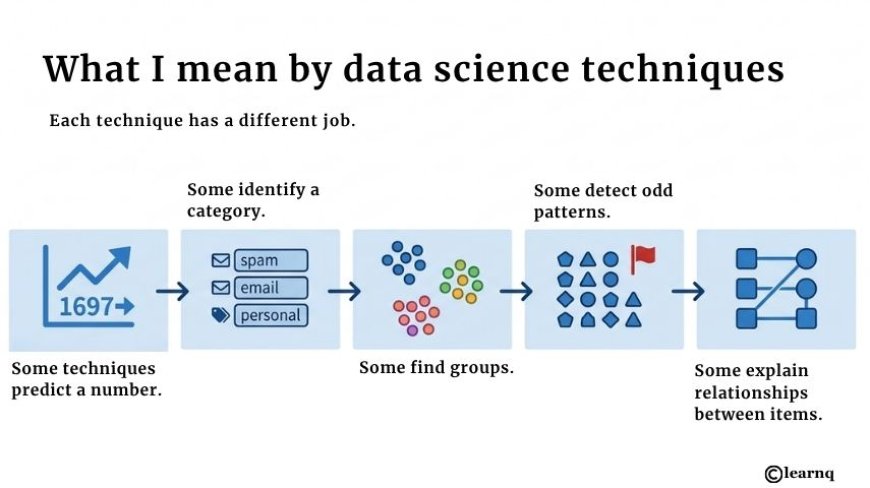
Each technique has a different job.
- Some techniques predict a number.
- Some identify a category.
- Some find groups.
- Some detect odd patterns.
- Some explain relationships between items.
This is why data science is not one single method. It is a set of approaches that work together.
Classification: sorting Data Science into groups
Classification is one of the most common data science techniques in analytics.
It answers a simple question: Which category does this belong to?
A few examples:
- Is this email spam or not?
- Will this customer leave or stay?
- Is this transaction safe or suspicious?
- Which type of product is this?
Classification is useful because many business problems are about choosing the right label.
Common classification methods include decision trees, logistic regression, Naïve Bayes, support vector machines, k-nearest neighbors, and neural networks. Each one has strengths. Decision trees are easy to explain. Logistic regression works well for clear binary choices. Neural networks handle more complex patterns. The choice depends on the problem, the data, and the goal.
Regression: predicting numbers
Regression is used when the answer is a number, not a category.
For example:
- How much revenue may a store earn next month?
- What will the house price be?
- How many users will sign up this week?
- What is the likely temperature tomorrow?
Regression is one of the most useful parts of data science modeling because many business questions are about value, size, or amount. Linear regression is often the first method learners study. It finds the best line to describe the relationship between variables. More advanced versions, such as multivariate regression and lasso regression, help when the data has more complexity. Regression remains one of the strongest tools in analytics because it is simple enough to explain and useful enough to trust.
Clustering: finding natural groups
Clustering is different from classification. In classification, the categories are already known. In clustering, the goal is to discover groups that already exist in the data.
A few examples:
- Which customers behave similarly?
- Which products are often bought together?
- Which website visitors follow the same pattern?
- Which students need similar support?
This makes clustering very useful in marketing, product design, customer analysis, and behavior study.
Common methods include k-means clustering, hierarchical clustering, DBSCAN, mean-shift clustering, and Gaussian mixture models. Clustering is especially helpful when the business does not yet know what the important groups are. It often reveals patterns that would be hard to spot by eye.
Anomaly detection: spotting what does not fit
Some of the most valuable work in analytics comes from finding the unusual.
Anomaly detection helps identify records or events that do not match expected patterns. These odd cases may be mistakes, fraud, system errors, or early warning signs.
Examples include:
- A credit card purchase far from normal behavior
- A machine reading outside its usual range
- A sudden drop in website traffic
- A strange shift in customer orders
This is one of the most practical uses of analytics because unusual patterns often matter more than average ones. In many industries, catching the rare event early can save time, money, and trust.
Association analysis: learning what appears together
Association analysis looks at relationships between items. It answers questions like:
- What products are often bought together?
- Which actions usually happen in sequence?
- What combinations appear again and again?
A common example is retail basket analysis. If people who buy a laptop also often buy a mouse, that pattern can guide product placement, recommendations, and promotions.
This technique is simple in idea but very useful in practice.
Why these Data Science techniques still matter in 2026
Some people think new tools replace old ones. In analytics, that is rarely true.
What happens instead is that new technology adds power to proven methods.
Neural networks may get more attention. Large language models may get more headlines. Yet regression, clustering, classification, and anomaly detection still support a huge amount of real work. They remain useful because they are flexible, reliable, and easy to apply across industries. That is why data science techniques continue to shape the future of analytics. They do not fade away when a new trend appears. They adapt.
Data science modeling is becoming more practical
A few years ago, many teams focused mainly on building models. Today, the focus is broader. The question is not only “Can we train a model?” but also:
- Does the model solve a business need?
- Is it easy to maintain?
- Can people understand it?
- Is it fair and accurate?
- Does it work on real data?
This is where data science modeling has become more practical and more business-focused.
The model is no longer the final goal. It is one part of a larger system that includes data quality, interpretation, deployment, monitoring, and decision support.
The role of data science in modern analytics teams
Analytics teams today need more than technical skill. They also need problem-solving, communication, and good judgment.
A strong analyst or data scientist should be able to:
- Choose the right technique
- Explain why it was chosen
- Test the result
- Describe the business meaning
- Suggest the next step
This is why data science is valuable in almost every sector. It is not just about code. It is about turning data into action.
A simple example
Imagine an online store wants to understand why some customers stop buying.
A data team could use:
- classification to predict whether a customer will leave
- clustering to group similar customer types
- regression to estimate future spending
- anomaly detection to find unusual behavior
- association analysis to see which products are often purchased together
One problem can use several techniques. That is what makes analytics powerful. Each method gives a different view of the same situation.
Why learners should study these techniques early
For anyone building a career in analytics, learning these methods early is a smart move. It helps create a better data science roadmap and makes later topics easier to understand.
A good learning path often includes:
- introduction to data science
- Python and SQL
- statistics
- data cleaning
- visualization
- classification and regression
- clustering and anomaly detection
- project work
- portfolio building
- certification
This structure helps learners move from basic understanding to practical application.
How IABAC fits into this journey
For learners who want a structured path, IABAC offers Data Science Certification options through its site, https://iabac.org. A certification can help learners organize their study, strengthen their knowledge, and build confidence in practical skills. It is most useful when combined with projects. That combination of learning plus application matters a lot in analytics careers.
Final thoughts
Data science techniques continue to shape the future of analytics because they help people make sense of complex data in clear, useful ways. Classification helps sort. Regression helps predict. Clustering helps group. Anomaly detection helps spot unusual events. Association analysis helps find patterns. Data science modeling connects all of these into useful action. The future of analytics will not be based on one method alone. It will be built on the careful use of many techniques, each used for the right problem. That is what makes data science so important. It does not just study data. It helps people understand what the data is trying to say.