Demand for ML Operations Engineers Continues to Grow as AI Adoption Expands in 2026 Worldwide
Learn how AI strategy consulting helps enterprises plan AI adoption, identify use cases, manage risks, improve operations, and align technology with goals.

Let's talk numbers, because numbers don't lie (unlike some machine learning models trained on bad data).
According to industry reports and workforce analytics tracked in early 2026, the global artificial intelligence market is projected to surpass $800 billion USD by 2030, growing at a compound annual growth rate (CAGR) of approximately 37–38%. Within this explosion, ML Operations — or MLOps — has emerged as one of the fastest-growing engineering disciplines on the planet. Job postings for ML Operations Engineers grew by over 70% year-over-year between 2024 and 2026 across North America, Europe, Southeast Asia, and the Middle East. This isn't a fad. This is the tectonic shift of data science moving from "experimental lab work" to "production-grade infrastructure that runs hospitals, banks, and self-driving cars."
The demand is real. The salaries reflect it. The career opportunities are extraordinary. And yet, the global supply of trained, certified ML Operations professionals still lags far behind what the market needs.
What Is MLOps, Really?
You may have heard the term thrown around in tech conversations, LinkedIn posts, and enthusiastic conference panels. But what does an ML Operations Engineer actually do?
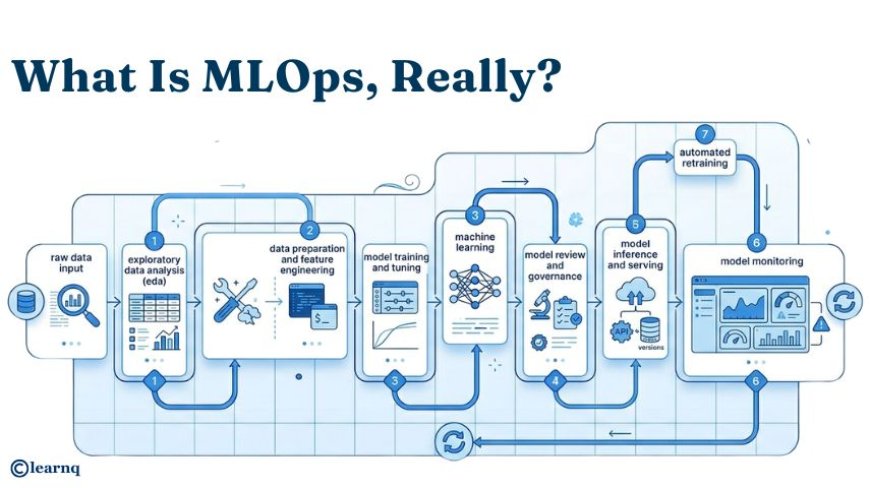
MLOps — Machine Learning Operations — is the discipline of taking machine learning models from development into production, and then keeping them alive, healthy, monitored, and continuously improving over time. Think of it this way. A data scientist is like a chef who creates a stunning recipe. An ML Operations Engineer is the person who builds the kitchen, manages the supply chain, sets up the health inspections, trains the kitchen staff, and makes sure 10,000 customers can be served that dish every single day without anyone getting food poisoning.
The ML lifecycle — from raw data to a deployed, monitored model — involves a series of complex, interconnected stages:
1. Exploratory Data Analysis (EDA) — Understanding the raw data, finding patterns, spotting anomalies, and forming hypotheses.
2. Data Preparation and Feature Engineering — Cleaning, transforming, aggregating, and structuring data into usable features. A feature store makes these features shareable across teams.
3. Model Training and Tuning — Using frameworks like scikit-learn, TensorFlow, PyTorch, or AutoML tools to build and iteratively improve model performance. Hyperparameter tuning (adjusting batch sizes, learning rates, regularization terms) is a craft of its own.
4. Model Review and Governance — Tracking model lineage, version control, and audit trails using platforms like MLflow. Ensuring regulatory compliance.
5. Model Inference and Serving — Deploying models via REST API endpoints, managing latency, and ensuring real-time or batch inference works at scale.
6. Model Monitoring — Detecting data drift, concept drift, and performance degradation in production. Setting up alerts.
7. Automated Retraining — Building pipelines that automatically retrain models when performance drops below acceptable thresholds.
Each of these stages requires not just technical skill, but operational discipline — the hallmark of a true ML Operations Engineer.
Why the World Needs More MLOps Engineers in 2026
Here's the reality: roughly 87% of machine learning projects never make it to production. That statistic has haunted the data science world for years. The reasons vary — poor infrastructure, siloed teams, lack of monitoring, absence of CI/CD pipelines for ML — but they all trace back to one root cause: the gap between building a model and operating one.
This is precisely why organizations worldwide are hiring ML Operations Engineers at a pace that outstrips supply.
Consider the following sectors where MLOps expertise is now non-negotiable:
- Healthcare — AI diagnostic tools must be monitored continuously. A model that predicted pneumonia accurately in 2023 may drift as imaging technology or patient demographics change. MLOps ensures these models stay reliable and safe.
- Finance — Fraud detection models run 24/7. Even a 0.5% drop in recall (the ability to catch fraudulent transactions) can cost millions. MLOps pipelines detect such drift instantly and trigger retraining.
- Retail and E-Commerce — Recommendation engines and dynamic pricing models must adapt to seasonal trends, changing customer behavior, and new product catalogs. MLOps automates this adaptation.
- Manufacturing — Predictive maintenance models that forecast equipment failure need to be continuously validated against real-world sensor data. An incorrect prediction can shut down an entire production line.
- Autonomous Systems — Self-driving vehicles, drones, and robotics rely on ML models that must be versioned, tested, and deployed with surgical precision. A bad model update isn't just a software bug — it's a safety risk.
The Metrics That Make MLOps Critical
Let's get mathematical for a moment, because MLOps is not just about processes — it's about measurable outcomes.
Model Drift is one of the most important concepts in MLOps. It happens when the statistical distribution of the input data in production diverges from the training data. Mathematically, this is often measured using the Population Stability Index (PSI):
PSI = Σ (Actual% − Expected%) × ln(Actual% / Expected%)
A PSI below 0.1 means the model is stable. Between 0.1 and 0.2 indicates minor drift worth monitoring. Above 0.2 is a red flag — the model likely needs retraining.
Inference Latency is another critical metric. For real-time applications, models must respond within milliseconds. An e-commerce recommendation engine that takes 3 seconds to respond will cost the business in cart abandonment. MLOps engineers optimize model serving infrastructure — through quantization, distillation, or GPU acceleration — to keep latency under control.
Model Accuracy Degradation over time is tracked using rolling performance windows. For example, a credit risk model might be evaluated on a 30-day rolling accuracy window. If accuracy drops below a defined threshold — say, from 94% to 89% — an automated retraining pipeline is triggered.
These aren't abstract concepts. They are the daily operational reality of every ML Operations Engineer working in production environments today.
MLOps vs. DevOps: The Cousin You Didn't Know You Had
DevOps brought the software world the gift of continuous integration and continuous deployment (CI/CD). MLOps borrows that philosophy and extends it to machine learning.
In traditional DevOps, you version code. In MLOps, you version code, data, AND models. That's three dimensions of versioning, tracking, and governance happening simultaneously.
A DevOps pipeline pushes a new app version to production. An MLOps pipeline pushes a new model version — but only after it has passed validation tests, fairness checks, performance benchmarks, and bias audits. The stakes are different. The tooling is different. The expertise required is different. This is why companies cannot simply hand MLOps responsibilities to a DevOps engineer and call it a day. They need professionals who understand both worlds: the mathematical underpinnings of machine learning AND the operational rigor of production software systems.
The Rise of LLMOps: A New Frontier
If traditional MLOps wasn't complex enough, 2024 and 2025 introduced the world to large language models (LLMs) at unprecedented scale — and with them, a new sub-discipline: LLMOps.
Training and deploying large language models differs from traditional MLOps in several important ways:
- Computational Resources — Training even a moderately-sized LLM requires thousands of GPU-hours. Inference costs are enormous. Model compression, quantization, and distillation become essential operational skills, not optional extras.
- Transfer Learning and Fine-Tuning — Rather than training from scratch, organizations fine-tune foundation models on domain-specific data. Managing these fine-tuning pipelines, tracking which version was trained on which dataset, and ensuring reproducibility is a full-time operational challenge.
- Reinforcement Learning from Human Feedback (RLHF) — Modern LLMs are improved through human feedback loops. MLOps engineers must build and maintain these feedback pipelines, integrating user ratings, corrections, and preferences back into the training cycle.
- Evaluation Metrics — Unlike traditional models with clear accuracy metrics, LLMs are evaluated using metrics like BLEU (Bilingual Evaluation Understudy) for translation tasks, ROUGE (Recall-Oriented Understudy for Gisting Evaluation) for summarization, and increasingly, human preference scores. Managing these multi-dimensional evaluation frameworks is an operational challenge in itself.
In 2026, every organization deploying generative AI applications — from customer service chatbots to legal document analyzers — needs LLMOps engineers who can manage these complexities at scale.
The Career Opportunity: A Worldwide Perspective
The demand for ML Operations Engineers is not confined to Silicon Valley. It is a worldwide phenomenon.
In North America, major technology companies, financial institutions, and healthcare systems are competing fiercely for MLOps talent. Average salaries for senior ML Operations Engineers in the United States range from $160,000 to $220,000 USD annually, with additional equity compensation at tech firms.
In Europe, financial services firms in London, Frankfurt, and Amsterdam are building out MLOps teams to comply with the EU AI Act — a landmark regulation requiring transparency, monitoring, and auditing of AI systems deployed in high-risk categories.
In Southeast Asia, markets like Singapore, India, and Indonesia are witnessing explosive growth in AI adoption across fintech, e-commerce, and logistics, driving demand for MLOps professionals who can build scalable ML infrastructure in resource-efficient environments.
In the Middle East and Africa, Vision 2030 initiatives and smart city programs are creating entirely new markets for AI and MLOps expertise.
The common thread across all these regions? A significant shortage of qualified professionals who understand both the data science and operations sides of machine learning. Organizations are paying premium salaries, offering remote work flexibility, and sponsoring international relocations to fill these roles.
What Skills Does an ML Operations Engineer Need?
The role of an ML Operations Engineer sits at the intersection of several disciplines. Here is what the market demands in 2026:
- Programming — Python is the lingua franca of ML, but MLOps engineers also need familiarity with Bash scripting, YAML configuration, and sometimes Go or Java for infrastructure tooling.
- ML Frameworks — Hands-on experience with scikit-learn, TensorFlow, PyTorch, and XGBoost. Understanding of model serialization formats (ONNX, PMML, pickle).
- MLOps Platforms — MLflow for experiment tracking, Kubeflow or Apache Airflow for pipeline orchestration, and cloud-native solutions on AWS SageMaker, Google Vertex AI, or Azure Machine Learning.
- CI/CD for ML — Adapting traditional CI/CD pipelines (GitHub Actions, Jenkins, GitLab CI) to handle model training, validation, and deployment workflows.
- Containerization and Orchestration — Docker and Kubernetes are essential for deploying models as scalable, reproducible microservices.
- Data Engineering Fundamentals — Understanding data pipelines, stream processing (Kafka, Flink), and feature stores (Feast, Tecton).
- Monitoring and Observability — Setting up dashboards, alerts, and drift detection for production models using tools like Prometheus, Grafana, and purpose-built ML monitoring solutions.
- Statistical and Mathematical Understanding — You don't need to derive backpropagation from scratch, but you must understand concepts like precision, recall, F1 score, AUC-ROC, PSI, and the bias-variance tradeoff to make intelligent operational decisions.
The Certification Advantage: Why Credentials Matter More Than Ever
Here's an uncomfortable truth: in a job market flooded with self-proclaimed "AI experts," employers are increasingly turning to certifications to filter for verified competence. A structured, industry-recognized certification in data science and ML operations signals to employers that you have completed rigorous, standardized training — not just watched a few YouTube videos and called yourself a machine learning engineer. For professionals worldwide looking to enter or advance in the MLOps space, obtaining a data science certification is increasingly a prerequisite rather than a differentiator. Structured programs that cover the introduction to data science, the data science roadmap, data science syllabus components, and hands-on data science projects provide the foundational knowledge that employers trust.
Whether you're pursuing a Certification in Data Science Online to fit around your existing commitments, or exploring what is the data science discipline before pivoting your career, accredited programs provide a structured path from data to data insights to production-ready ML systems. IABAC (International Association of Business Analytics Certifications) is one such platform, offering globally recognized credentials in data science and AI that are trusted by professionals across more than 170 countries. Their certifications are designed to cover the practical, real-world skills that ML Operations Engineers need — from the introduction to data science fundamentals all the way through advanced MLOps practices. You can explore their full range of offerings at certifications.
The data science roadmap taught through structured certification programs typically covers:
- Statistical foundations and probability theory
- Data wrangling, EDA, and feature engineering
- Supervised and unsupervised learning
- Model evaluation and selection
- Deployment pipelines and MLOps fundamentals
- Ethics, governance, and regulatory compliance in AI
This structured datascience curriculum is what separates professionals who can talk about machine learning from those who can actually run it in production.
A Day in the Life of an ML Operations Engineer
Let's make this concrete. Here's what a typical day for an ML Operations Engineer might look like at a mid-sized fintech company:
8:30 AM — Morning monitoring dashboard review. One of the fraud detection models shows a PSI of 0.18 — borderline. Not an emergency, but worth watching. Flag it for the team.
9:15 AM — Meeting with the data science team to review a new model candidate. The data scientist achieved 96.2% AUC-ROC on the validation set. But after running it through the deployment checklist — checking for training-serving skew, verifying feature availability at inference time, confirming latency requirements — two issues are discovered. They need to be resolved before the model is production-ready.
11:00 AM — Working on the CI/CD pipeline for the upcoming model refresh. This involves writing configuration files, setting up automated tests, and ensuring the model registry in MLflow is properly updated with the new version, its metadata, and its lineage.
1:30 PM — Responding to an alert: one of the recommendation models has seen a 3% drop in click-through rate over the past 72 hours. Is it model drift, a data pipeline issue, or an A/B test interaction? Investigation begins.
3:00 PM — Training a junior team member on how to set up Grafana dashboards for model performance monitoring. Knowledge transfer is part of the job.
4:30 PM — Documentation update and end-of-day check. All models green except the fraud model from the morning. Ticket raised for the data science team to investigate potential retraining.
This is the rhythm of ML Operations: vigilant, systematic, cross-functional, and deeply technical.
The Road Ahead: MLOps in 2026 and Beyond
The trajectory is clear. As AI adoption deepens across every industry — from agriculture using satellite imagery and ML to optimize crop yields, to judicial systems using AI to manage case backlogs, to climate scientists using deep learning to model atmospheric patterns — the need to operate these systems reliably and responsibly will only grow.
Several trends are shaping the MLOps landscape as we move through 2026:
- AutoMLOps — Tools that automate portions of the MLOps pipeline itself, from automated feature selection to self-healing model retraining, are maturing rapidly.
- Federated Learning Operations — As privacy regulations tighten globally, training models on distributed, privacy-preserving data sources without centralizing raw data is becoming a mainstream requirement. Operating federated ML systems is a specialized MLOps challenge.
- Responsible AI and Model Governance — Regulators worldwide are mandating explainability, fairness audits, and bias checks for AI systems in high-stakes domains. MLOps engineers are increasingly responsible for building the governance frameworks that satisfy these requirements.
- Edge MLOps — Deploying and managing ML models on edge devices — IoT sensors, mobile phones, embedded systems — introduces new constraints around model size, latency, and update mechanisms that traditional cloud MLOps pipelines don't address.
Each of these trends represents a new specialization within MLOps — and a new category of career opportunity for professionals with the right skills and certifications.
Getting Started: Your Data Science Roadmap to MLOps
If you're reading this and thinking, "This is the career I want," here's a practical roadmap:
Step 1: Build Your Foundation Start with the fundamentals of data science — statistics, Python, data manipulation with Pandas, and exploratory data analysis. Understanding what is the data science discipline at its core is non-negotiable before you can operate ML systems.
Step 2: Learn Machine Learning Work through a structured data science syllabus that covers supervised learning (regression, classification), unsupervised learning (clustering, dimensionality reduction), and model evaluation. Complete at least two end-to-end data science projects that take a problem from raw data to a trained, evaluated model.
Step 3: Get Certified Pursue a recognized certification for data science from a credible institution. A Certification in Data Science Online from IABAC provides flexibility for working professionals and delivers industry-aligned credentials recognized globally. Visit IABAC to explore programs aligned with your career goals.
Step 4: Learn MLOps Tooling Dive into MLflow, Docker, Kubernetes, Airflow, and cloud ML platforms. Build your own MLOps pipeline as a learning project — train a model, package it in a container, deploy it as an API, set up monitoring, and automate retraining.
Step 5: Specialize Depending on your interests and target industry, specialize in LLMOps, edge deployment, federated learning, or responsible AI governance.
Step 6: Contribute and Network Contribute to open-source MLOps projects, write technical blog posts, participate in MLflow or Kubeflow community discussions, and attend ML and AI conferences. The MLOps community is global, collaborative, and genuinely welcoming to newcomers.
The World Is Waiting for ML Operations Engineers
The global AI revolution is not slowing down. If anything, 2026 is the year the world realizes that building AI is only half the battle — the harder half is running it reliably, ethically, and at scale. ML Operations Engineers are the professionals who make that possible. They are the invisible backbone of every AI application that works in production. They are the reason your bank catches fraudulent transactions before you notice them. They are the reason your doctor's AI diagnostic assistant is trustworthy today and will be equally trustworthy six months from now when the model has been updated.
The demand for their skills is surging worldwide. The compensation is exceptional. The career trajectory is steep and exciting. And the tools, platforms, and structured learning paths — including world-class data science certification programs available through institutions like IABAC — have never been more accessible. If you've been thinking about entering the field of data science and ML operations, there has never been a better time. The world doesn't just want ML Operations Engineers. It desperately needs them. Start your journey today.