
Companies Are Hiring More ML Operations Engineers
As AI projects grow, organizations need ML Operations Engineers to manage deployment, monitoring, automation, and model performance at scale in 2026.

A few years ago, building an AI model was often seen as the hardest part of an AI project. Teams spent weeks collecting data, training models, and testing results. When the model finally produced accurate predictions, everyone celebrated. Then something unexpected happened.
The model was deployed.
Suddenly, new challenges appeared. The data started changing. Predictions became less accurate. Users reported issues. Updates were difficult to manage. What looked perfect in a testing environment struggled when faced with real business conditions. This is exactly why companies around the world are hiring more ML Operations Engineers. Organizations are investing heavily in artificial intelligence, machine learning, and automation. However, an AI model only creates value when it can operate reliably after deployment. Businesses need professionals who can manage machine learning systems, monitor performance, automate updates, and ensure models continue delivering accurate results over time. As AI projects become larger and more complex, ML Operations Engineers have become one of the most important professionals in modern technology teams.
The Hidden Side of AI Success
When people think about artificial intelligence, they usually imagine data scientists building smart models or software developers creating applications. Few people think about what happens after a machine learning model goes live.
Consider an online shopping platform that uses AI to recommend products.
The recommendation model may perform exceptionally well during development. However, customer behavior changes constantly. New products are added every day. Seasonal trends affect purchasing decisions. Without proper monitoring and maintenance, recommendation quality can decline quickly.
The same challenge exists in:
- Healthcare prediction systems
- Financial risk models
- Fraud detection platforms
- Manufacturing quality systems
- Customer service chatbots
- Generative AI applications
A machine learning model is not something that can simply be built and forgotten.
It requires continuous attention.
This responsibility often falls to ML Operations Engineers.
Why AI Projects Need MLOps
MLOps, or Machine Learning Operations, focuses on managing the complete lifecycle of machine learning systems. Instead of treating machine learning as a one-time project, MLOps creates a structured process for building, deploying, monitoring, and improving models.
A simple MLOps workflow looks like this:
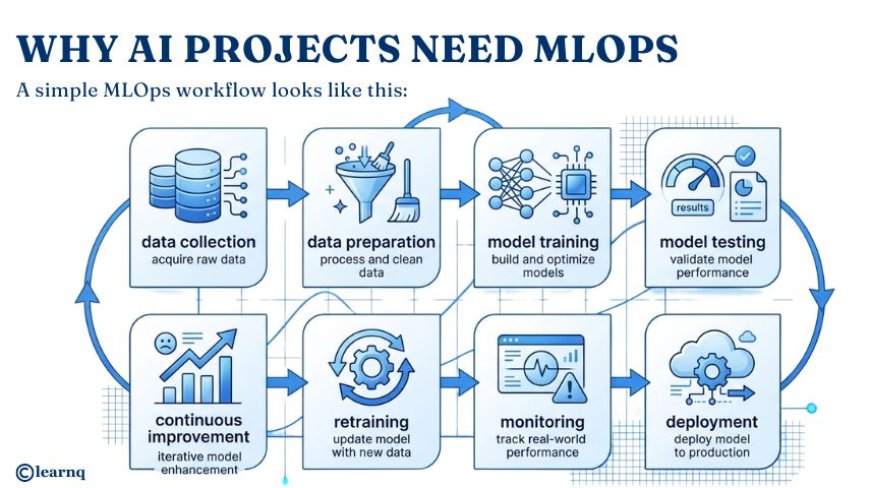
Without this process, companies often face delays, inconsistent results, and operational challenges.
With MLOps, teams can release updates faster while maintaining quality and reliability.
The Growing Demand for ML Operations Engineers
The growth of AI adoption has created a new challenge for organizations.
Many companies successfully build machine learning models, but fewer know how to manage hundreds of models running simultaneously.
Imagine an organization operating:
- 20 recommendation models
- 15 fraud detection models
- 10 customer support AI systems
- Multiple forecasting and analytics models
Managing these systems manually would require enormous effort.
ML Operations Engineers help automate these processes so organizations can scale AI initiatives efficiently. As more businesses move from experimentation to full AI implementation, demand for professionals who understand deployment, monitoring, automation, and infrastructure continues to increase.
What Does an ML Operations Engineer Actually Do?
An ML Operations Engineer works between data science and software engineering teams.
Their responsibilities often include:
- Building ML Pipelines: They create automated workflows that move data from source systems into machine learning environments.
- Deploying Models: Once a model is ready, they ensure it can run efficiently in production systems.
- Monitoring Performance: They track model accuracy, response times, and operational metrics.
- Managing Infrastructure: They work with cloud platforms, containers, and computing resources required for machine learning workloads.
- Automating Retraining: When model performance drops, automated processes can retrain models using updated data.
- Supporting Collaboration: ML Operations Engineers help data scientists, software engineers, and IT teams work together effectively.
Why Students Are Paying Attention to This Career
Many learners start their journey by asking:
- What is the data science process?
- What is the introduction to data science?
- How does a data science project become a real product?
- Which data science certification should I choose?
These questions often lead to MLOps.
Traditional data science focuses on building models and generating insights.
MLOps focuses on keeping those models useful after deployment.
Because of this connection, many professionals studying data science, following a data science roadmap, or completing a data science project eventually become interested in ML Operations. The combination of data science knowledge and operational skills creates strong career opportunities.
Skills Needed for ML Operations Careers
People entering this profession typically develop skills in several areas.
- Machine Learning Fundamentals: Understanding how models are trained and evaluated remains important.
- Programming: Python continues to be one of the most commonly used languages.
- Cloud Platforms: Organizations increasingly deploy machine learning systems using cloud infrastructure.
- DevOps Concepts: Version control, automation, testing, and deployment practices are valuable.
- Monitoring and Observability: Tracking system health and model behavior is a major responsibility.
- Communication: ML Operations Engineers regularly coordinate with multiple teams.
How Data Science Certifications Can Help
Many employers value candidates who combine practical experience with structured learning.
A data science certification can help learners build foundational knowledge in statistics, machine learning, data analysis, and programming. Many professionals also explore Certification in Data Science Online programs because they provide flexibility while developing relevant skills.
Topics often covered include:
- Introduction to Data Science
- Machine Learning
- Python Programming
- Data Visualization
- Data Science Syllabus Fundamentals
- Model Development
- Data Engineering Concepts
For learners planning a long-term career, certifications can complement hands-on projects and practical experience.
A Career That Continues to Grow
The future of AI depends on more than creating intelligent models.
Organizations need professionals who can keep those models running effectively month after month and year after year. As businesses expand their AI initiatives, the importance of ML Operations Engineers continues to increase. Companies no longer view machine learning as an experimental technology. They view it as an important part of business operations. That shift is creating new opportunities for professionals who understand both machine learning and operational excellence. For anyone exploring data science, building a data science roadmap, completing a data science project, or pursuing a data science certification through organizations such as IABAC, understanding MLOps can be a valuable step toward future career growth. The AI revolution may begin with data scientists creating models, but many successful AI projects continue because ML Operations Engineers keep them running.