Agentic AI Sparks New Interest Among Technology Companies in the USA
Agentic AI is gaining attention among US technology companies for task automation, smarter workflows, business efficiency, and AI innovation in 2027.
Imagine having a digital assistant that does not simply answer your questions but also understands your goals, creates a plan, completes tasks, checks its progress, and adjusts its actions when something goes wrong. You do not have to explain every little step or remind it what to do next. It can take responsibility for completing an assigned task within the permissions you give it.
Sounds interesting, right?
This is the idea behind Agentic AI, one of the most talked-about developments in artificial intelligence. Technology companies across the USA are showing growing interest in AI systems that can do more than generate text, respond to questions, or recommend products. Businesses are now looking at intelligent AI agents that can coordinate activities, support employees, automate complex workflows, and help teams complete work more efficiently. The growing interest is not limited to large technology companies. Startups, financial institutions, healthcare organizations, retail businesses, manufacturing companies, and educational institutions are also considering how agentic artificial intelligence can support their operations. For students and aspiring technology professionals, this shift creates an important question: Are the AI skills learned today enough for tomorrow's workplace? Understanding Agentic AI, its applications, and its technical requirements can help learners prepare for emerging opportunities. It also creates an opportunity for EdTech companies and training institutes to introduce relevant AI learning and certification pathways. Through its certification framework, IABAC (International Association of Business Analytics Certifications) supports professional competency development in Artificial Intelligence, Data Science, and Business Analytics.
What Is Agentic AI? Understanding the Meaning Behind the Technology
Before understanding why companies in the USA are interested in this technology, it is important to understand the concept itself. The Agentic AI definition describes artificial intelligence systems designed to work towards specific goals by planning tasks, making decisions, using available tools, and taking actions with a degree of autonomy. Traditional AI systems generally respond to instructions or questions. For example, a chatbot can explain a technical concept, generate an email, or summarize a document. However, a more advanced agentic system can take a larger objective and perform multiple connected activities to achieve it.
What Does Agentic Mean in Artificial Intelligence?
The word agentic refers to the ability to act independently towards a defined objective. In simple terms, agentic means that a system can make decisions about the next steps required to complete a task rather than waiting for instructions at every stage.
For example, consider a company that wants to prepare a monthly sales report. A conventional AI assistant might summarize the sales figures when an employee provides the information.
An AI agent could potentially:
- Collect sales information from authorized business systems.
- Organize and process the information.
- Identify unusual changes in sales performance.
- Compare current results with previous periods.
- Prepare a report with relevant findings.
- Send the report for human review.
The difference is the ability to coordinate several activities towards one objective.
Agentic AI Meaning: How Is It Different from Generative AI?
Generative AI and Agentic AI are connected, but they are not identical.
Generative AI focuses on creating content, including text, images, code, and summaries. Agentic AI focuses on completing tasks and achieving goals through reasoning, planning, and actions. It may use generative AI models as part of its working process. For instance, generative AI can write a marketing email. An agentic system could identify an approved customer segment, prepare the email, check it against defined rules, and submit it for human approval before sending. This does not mean every AI agent operates independently without supervision. Its permissions, capabilities, and decision-making authority depend on how the system is designed.
Why Are Technology Companies in the USA Showing Interest in Agentic AI?
The USA has a strong technology ecosystem, with businesses investing in cloud computing, automation, artificial intelligence, software development, and enterprise technology. As organizations look beyond basic AI assistants, they are evaluating how AI agents can support complete business processes. A 2026 McKinsey global survey on AI adoption reported that 40% of respondents from large organizations with annual revenues above $1 billion said their organizations were scaling AI agents, compared with 27% in the previous year. The survey also highlighted growing adoption of agentic coding tools.
This indicates that interest is moving beyond experimentation, particularly among larger organizations.
Several factors are contributing to this development.
1. Businesses Want More Than Basic Automation
Traditional automation works well when tasks follow fixed instructions. However, business processes often involve changing information, unexpected situations, and multiple decision points. Agentic AI can help address some of these challenges by allowing systems to assess information and select suitable next actions within defined limits. For example, a customer service agent may classify a customer request, retrieve relevant information, check an order status, and prepare a response. Requests involving refunds or sensitive account changes can still be sent to a human employee for approval.
2. Companies Are Looking for Better Productivity
Employees spend considerable time on repetitive activities such as preparing reports, organizing information, reviewing documents, and updating internal systems. AI agents can potentially reduce the time spent on these tasks. Technology companies are therefore investigating agentic workflows that allow employees to focus more on problem-solving, planning, customer relationships, and creative work. The objective is not necessarily to replace every employee. It is to identify activities where intelligent automation can support human capabilities.
3. Software Development Is Changing
Software development is another area receiving attention. AI coding agents can assist developers with writing code, reviewing changes, identifying errors, preparing documentation, and completing selected development tasks. For example, a developer may assign an AI agent a specific task, such as reviewing a particular section of an application. The agent can inspect the relevant code, suggest modifications, and prepare changes for developer review. Human oversight remains important because generated code must be tested for functionality, security, and quality.
4. Businesses Want Connected Workflows
Many companies use different software platforms for customer management, finance, communication, operations, and reporting. AI agents can connect with authorized tools through APIs and help coordinate activities between systems. This makes agentic AI particularly interesting for organizations that want to reduce unnecessary manual work across departments.
How Do AI Agents Work?
Understanding how AI agents function is important for anyone planning to build a career in artificial intelligence.
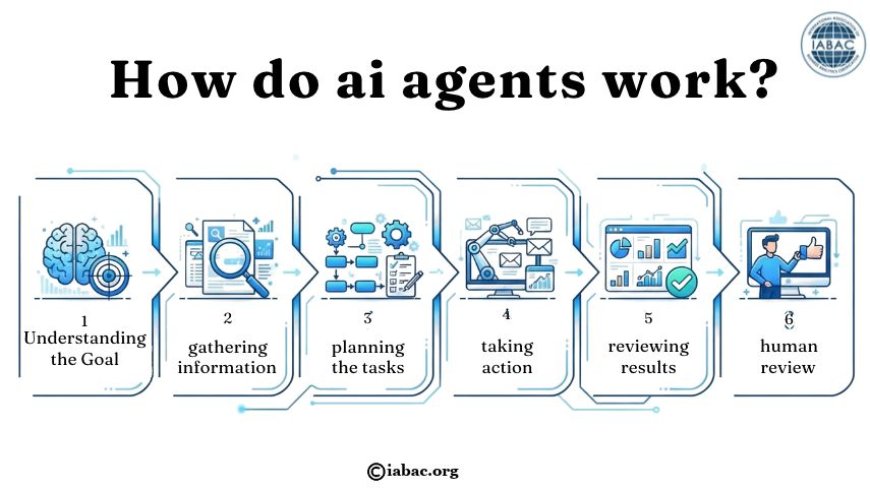
An AI agent generally works through a repeated process involving perception, reasoning, planning, action, and feedback.
1. Understanding the Goal: The system receives an objective from a user or another authorized system. It identifies what needs to be completed.
2. Gathering Information:The agent collects relevant information from permitted data sources, documents, applications, or APIs.
3. Planning the Tasks: It divides the larger objective into smaller activities and determines the order in which they should be performed.
4. Taking Action: The agent uses available tools to complete assigned activities. These actions may include retrieving information, processing data, generating content, or interacting with business applications.
5. Reviewing Results: The system checks whether the completed activities meet the intended objective. If something is missing, it may revise its approach within its permitted capabilities.
6. Human Review: For important decisions, financial transactions, sensitive information, and other high-impact activities, human approval and supervision should remain part of the process.
This process makes agentic systems different from basic question-and-answer applications.
Where Are American Companies Applying Agentic AI?
The applications of Agentic AI are expanding across several industries. The following examples show how companies can use AI agents to support business activities.
Healthcare
Healthcare organizations can investigate AI agents for administrative activities such as appointment coordination, document processing, patient communication, and medical record organization. For example, an administrative agent could help organize appointment requests and identify available time slots. Medical decisions, diagnosis, and treatment recommendations require appropriate professional oversight.
Banking and Financial Services
Financial organizations handle large amounts of information and repetitive operational tasks.
AI agents can support:
- Document verification workflows.
- Customer query management.
- Transaction monitoring assistance.
- Financial report preparation.
- Internal compliance documentation.
Any system involved in financial decisions must operate under strict security, regulatory, and human approval requirements.
Retail and E-commerce
Retail companies can use AI agents to support inventory monitoring, customer support, product information management, and order-related communication. For example, an agent could identify a low-stock product, check inventory information, and prepare a purchase request for approval.
Manufacturing
Manufacturing businesses can investigate agentic systems for production monitoring, maintenance scheduling, supply chain coordination, and quality documentation. An AI agent could monitor equipment information, identify unusual patterns, and alert maintenance teams when inspection may be necessary.
Education and EdTech
Education providers can use AI agents to support learner enquiries, administrative communication, content organization, and assessment-related workflows. For training institutes, AI can also help organize learning resources and provide additional assistance to learners. However, educational institutions should maintain human oversight for grading policies, learner evaluations, certification decisions, and academic quality.
Emerging Agentic AI Trends Technology Professionals Should Watch in 2026
The growing interest in agentic artificial intelligence is creating several important technology trends.
1. Multi-Agent Systems
Instead of using one AI agent for every activity, companies are experimenting with systems where multiple agents work together.
For example, a business research workflow could include:
- A research agent that gathers information.
- An analysis agent that examines the findings.
- A reporting agent that prepares a summary.
- A review agent that checks the output.
Each agent has a specific responsibility, while an orchestration system coordinates the overall process. This approach can help manage complex tasks, although coordination, accuracy, and security remain important challenges.
2. Agentic AI in Software Engineering
AI coding agents are receiving attention from software companies because they can assist with several stages of development. Future workflows may involve agents supporting testing, debugging, code review, documentation, and software maintenance. Developers who understand programming, AI models, software architecture, and agent orchestration will be better prepared to work with these systems.
3. AI Agents for Business Operations
Organizations are increasingly interested in using AI agents beyond technical departments. nSales, marketing, customer support, finance, and human resources teams can all benefit from carefully designed AI-assisted workflows. For example, a marketing agent might organize campaign information, examine engagement results, and prepare suggestions for the marketing team.
4. Human-AI Collaboration
One important trend is the development of systems where AI agents and employees work together. AI can manage selected operational activities, while people provide judgment, creativity, approval, and accountability. This makes AI literacy and the ability to supervise intelligent systems important skills for professionals across different industries.
5. Responsible AI and Agent Governance
As AI agents receive access to more business tools and information, organizations must pay greater attention to security and governance.
Important considerations include:
- Data privacy and access permissions.
- Human approval for sensitive actions.
- Monitoring agent behaviour.
- Preventing unauthorized activities.
- Recording important system actions.
- Testing outputs before production deployment.
Businesses need professionals who understand both AI capabilities and the responsibilities involved in using them.
What Skills Do Students Need to Learn for an Agentic AI Career?
For students interested in artificial intelligence, Agentic AI offers an opportunity to build on existing technical knowledge. However, learning how to use an AI chatbot is not the same as learning how to develop an intelligent agent. A strong learning foundation should cover several areas.
- Programming and Python: Python is widely used in AI development. Learners should understand variables, functions, libraries, data structures, and application development.
- Machine Learning: Knowledge of machine learning helps professionals understand how AI systems identify patterns, make predictions, and process information.
- Large Language Models: Learners should understand how large language models work, including their capabilities, limitations, and common applications.
- Prompt Engineering: Clear instructions and structured prompts help improve interactions with language models.
- API Integration: AI agents frequently interact with external applications and services. Understanding APIs is useful for building connected workflows.
- Agent Frameworks: Students can learn how agent frameworks support tool usage, planning, memory, and coordination.
- Data Management: Knowledge of databases, data processing, and information security helps developers build reliable AI systems.
- AI Ethics and Governance: Professionals must understand responsible AI practices, data protection, transparency, and human supervision.
These skills provide a foundation for working with AI applications across different industries.
Career Opportunities Emerging Around Agentic AI
The development of agentic systems is creating new responsibilities within existing AI and technology roles.
Students and working professionals can consider several career directions.
AI Agent Developer
Designs and develops AI agents that interact with tools, process information, and complete assigned tasks.
AI Automation Engineer
Builds automated workflows that connect AI models with business applications and operational systems.
Machine Learning Engineer
Develops, tests, and maintains machine learning models that support intelligent applications.
AI Solutions Architect
Plans the technical structure of AI systems and determines how models, agents, APIs, and enterprise platforms work together.
AI Research Engineer
Works on improving AI models, reasoning capabilities, agent performance, and system reliability.
AI Governance Specialist
Supports organizations in developing policies, monitoring AI systems, managing risks, and maintaining responsible AI practices.
Data Scientist
Analyses information, develops predictive models, and supports AI projects through data-based insights.
These roles may require different levels of experience. Students can begin by learning programming and AI fundamentals before progressing towards specialized responsibilities.
Importantly, an AI certification alone does not guarantee employment. Practical skills, project experience, problem-solving ability, and continuous learning also matter.
Why Artificial Intelligence Certification Matters in the Agentic AI Era
As companies introduce more advanced AI applications, employers need professionals who can demonstrate their knowledge and technical understanding.
This is where Artificial Intelligence Certification becomes relevant.
A professional certification provides a structured way to validate knowledge in a particular subject area. It can help learners demonstrate their understanding of AI concepts, technologies, and professional competencies.
For beginners, certification can provide a clear learning direction. For working professionals, it can support career development and demonstrate a commitment to updating their technical knowledge.
For technology companies, certified professionals can contribute to building teams with a stronger understanding of AI technologies and their applications.
However, learners should choose certification pathways based on their current knowledge, career objectives, and the competencies they want to develop.
How IABAC Supports AI and Technology Skill Development
The growing interest in Agentic AI also highlights the importance of professional competency standards.
IABAC, the International Association of Business Analytics Certifications, provides professional certifications in Artificial Intelligence, Data Science, and Business Analytics.
Through its certification framework, IABAC supports learners and professionals seeking to validate their knowledge and strengthen their professional profiles.
The IABAC certification pathway can be relevant to individuals interested in building their understanding of artificial intelligence and related technologies.
Those interested in AI can review the IABAC Artificial Intelligence Certification page to understand the available certification pathway, relevant competencies, and certification information.
IABAC is a certification body rather than a direct training provider. Individuals who require structured instruction can connect with an IABAC Authorized Training Provider.
This distinction is important. Training providers deliver learning sessions, while IABAC provides the certification framework and associated assessment process.
An Opportunity for EdTech Companies and Training Institutes
Agentic AI is creating new opportunities not only for technology professionals but also for education businesses.
EdTech companies, universities, corporate training departments, and professional training institutes in the USA can consider introducing AI-focused learning and certification pathways to address changing workforce requirements.
However, launching an AI training program requires more than adding a few AI topics to an existing syllabus.
Education providers must consider:
- Whether the curriculum reflects current industry requirements.
- Whether trainers have relevant subject knowledge.
- Whether learners receive appropriate practical exposure.
- Whether assessments measure the required competencies.
- Whether the certification has a clear professional framework.
- Whether the program can remain relevant as AI technologies change.
An association with a recognized certification framework can help training organizations establish clearer academic and professional standards.
Through the IABAC Authorized Training Provider (ATP) Program, eligible education and training organizations can apply to become authorized providers of IABAC certification training.
The program supports curriculum alignment, trainer accreditation, and access to IABAC certification opportunities.
For EdTech businesses looking to expand their AI and Data Science offerings, this can provide an opportunity to strengthen their training portfolio.
Interested in becoming an IABAC Authorized Training Provider?
Visit https://iabac.org/partners/authorized-training-provider to review the partnership details and submit an enquiry.
Challenges Companies Must Consider Before Adopting Agentic AI
Although agentic AI offers several possibilities, businesses should not assume that every workflow needs an autonomous system.
Successful implementation requires careful planning.
- Accuracy and Reliability: AI agents can misunderstand instructions or produce incorrect outputs. Testing and monitoring are necessary.
- Data Security: Agents may access sensitive information through connected systems. Access should be restricted according to business requirements.
- Operational Costs: Running multiple AI agents and connecting them to external services can increase infrastructure and maintenance costs.
- Integration: Older enterprise applications may not easily support agent-based workflows. Integration planning is therefore important.
- Accountability: Companies must establish who is responsible when an AI agent makes an incorrect decision or performs an unintended action.
- Human Oversight: High-impact activities should include suitable approval and review processes.
These challenges show why organizations need professionals who understand AI development, business requirements, and responsible implementation together.
What Does the Future of Agentic AI Look Like in the USA?
The future of Agentic AI will depend on how successfully companies move from small experiments to reliable business applications.
Technology companies are likely to continue investigating multi-agent systems, AI-powered software development, workflow automation, and intelligent business assistants. At the same time, the conversation will increasingly involve security, governance, operational costs, and measurable business outcomes.
- For students, this means that learning artificial intelligence should not stop at understanding popular AI tools. Developing a strong foundation in programming, machine learning, data management, and responsible AI will provide more flexibility as technology changes.
- For professionals, the ability to work alongside AI systems and evaluate their performance may become increasingly valuable.
- For EdTech companies, the opportunity is to prepare learners with relevant competencies instead of simply following the latest technology trend.
The next generation of AI professionals will need to understand not only how intelligent systems work but also when they should be used, where human involvement is necessary, and how their performance can be evaluated.
Conclusion: Is Agentic AI the Next Major Opportunity for Technology Professionals?
Agentic AI is changing how technology companies in the USA think about automation, software development, and business operations. Instead of limiting artificial intelligence to answering questions or generating content, organizations are investigating systems that can plan activities, use tools, coordinate tasks, and work towards specific objectives. For students, this development creates opportunities to build skills in AI development, machine learning, automation, and intelligent systems. For working professionals, it offers new ways to strengthen technical knowledge and adapt to changing workplace requirements. For EdTech companies and training institutes, it presents an opportunity to introduce industry-aligned AI learning and certification programs. However, technology alone does not create professional expertise. The right knowledge, structured learning, practical understanding, and competency assessment remain important. IABAC supports professional development through its Artificial Intelligence, Data Science, and Business Analytics certification frameworks. Whether you are an individual looking to validate your AI knowledge or an education provider planning to expand your certification offerings, IABAC provides pathways to support these goals.
Start preparing for the next phase of artificial intelligence with IABAC.
Visit www.iabac.org to explore certification opportunities or learn more about becoming an Authorized Training Provider.
Frequently Asked Questions About Agentic AI
1. What is Agentic AI in simple words?
Agentic AI is a type of artificial intelligence that can work towards a specific goal by planning tasks, making decisions, using tools, and taking actions with a degree of independence.
2. What does agentic mean in AI?
Agentic means having the ability to act towards an objective rather than simply responding to an instruction. In AI, it describes systems that can plan and perform activities within defined permissions.
3. How is Agentic AI different from Generative AI?
Generative AI creates content such as text, images, and code. Agentic AI uses reasoning, planning, and tools to complete tasks. An agentic system may use generative AI as one of its components.
4. How can I get an Artificial Intelligence Certification from IABAC?
Visit the IABAC Artificial Intelligence Certification page at https://iabac.org/artificial-intelligence-certification to review the available certification information and application process.
5. Can training institutes become IABAC Authorized Training Providers?
Yes. Eligible training institutes, universities, and education organizations can apply through the IABAC Authorized Training Provider Program. Visit https://iabac.org/partners/authorized-training-provider for details.