How a Data Science Academy Can Support Your Career Goals in 2027
Learn how a data science academy helps build practical skills, gain industry knowledge, earn certification, and prepare for career opportunities in 2027
A data science academy gives you something a random pile of free tutorials can't: a clear order to learn things in, someone checking your work, and a certificate that means something to an employer. In 2027, the strongest academies combine core statistics, Python and SQL, applied machine learning, and hands-on projects, with an independent exam at the end, like the Data Science Certification tracks run through IABAC. If you're a beginner, an academy saves you from guessing what to learn first. If you're already working, it gives you a structured way to prove new skills without going back for a full degree. The right academy for you depends on your starting point, your goal, and how much proof of skill you actually need.
Key Takeaways
- A data science academy is not just a place to watch lessons. A good one gives you a set path, checks on your progress, and tests what you've actually learned.
- The value of a certificate goes up a lot when the group that grades you is separate from the group that taught you, which is how programs tied to independent bodies like IABAC are usually built.
- Certificate programs in data science work best as a step-by-step ladder: beginner analytics, then applied machine learning, then a specialty area.
- A short course can be a smart entry point if you're testing the waters, but a full academy program with a real final project builds a stronger case for employers.
- The biggest reasons people don't finish or don't get value are skipping the basics, hopping between tools, and ignoring how to explain results in plain language.
- Career paths coming out of a data science academy now include data analyst, data scientist, analytics engineer, MLOps engineer, and decision scientist, not just one single job title.
- 2027-ready academies teach some comfort with AI tools as a normal part of the work, not as a separate add-on class.
Introduction
If you've searched for a data science academy, you've probably found dozens of pages that all sound the same: big promises, shiny testimonials, and not much detail on what you'd actually learn or how you'd be tested. That's a real problem, because picking the wrong academy doesn't just waste money. It wastes months of your time, and it can leave you with a certificate that doesn't actually open any doors.
A good data science academy does three things well. It teaches you the right skills in the right order. It gives you a way to prove you actually learned them, usually through projects and an exam. And it connects that proof to something an employer will recognize and trust.
This guide walks through what a data science academy actually is, how the good ones are structured, what to expect from certificate programs in data science, which tools and skills matter in 2027, and how to build a realistic path from where you are now to where you want to be. We'll also look at how independent certification bodies like IABAC fit into the picture, since the way they separate teaching from testing is a good model for judging any academy you're considering.
1. What a Data Science Academy Actually Is
A data science academy is a training organization built around teaching the full range of data science skills, usually in a structured, multi-stage program, rather than a single one-off class. The word academy implies something bigger than a single course: a defined curriculum, a clear path from beginner to advanced, and usually some kind of assessment or certification at the end.
This is different from three things people often confuse it with:
- A single online course. A course teaches one topic or tool. An academy usually covers a full learning path across several courses.
- A university degree program. A degree takes years and usually covers a much wider academic base. An academy is normally faster and more focused on applied, job-ready skills.
- A YouTube or free-tutorial approach. Free content can be great for learning a single skill, but it rarely gives you a tested, recognized way to prove what you know.
A well-run data science academy sits in the middle: faster and more focused than a degree, but with more structure, testing, and credibility than a stack of free videos.
Why the Word Accredited or Certified Matters Here
Not every academy issues a certificate that means anything outside its own website. The strongest academies work with, or are directly tied to, an independent certification body. This is exactly why terms like Authorized Training Provider, Trainer Accreditation, and Accredited Academic Institution show up in this space. They describe a formal relationship where an outside group, such as IABAC, checks that the academy's teaching actually matches a recognized standard, and that the exam at the end is graded independently. If an academy can't clearly explain who checks its own quality, that's worth noticing.
2. How a Data Science Academy Works, Step by Step
Most academies, whatever their marketing style, run on a similar backbone. Here's a simple, text-based view of the usual flow:
Enroll → Skill Check / Placement → Foundations → Core Skills →
Applied Projects → Specialization (optional) → Final Project →
Independent Exam → Certificate → Career Support / Alumni Network
Step 1: Placement or skill check. A good academy doesn't put every student in the same starting point. It checks your background first, so a working analyst and a complete beginner aren't sitting through the exact same first lesson.
Step 2: Foundations. Statistics, probability, and basic programming (Python and/or SQL). This stage is often skipped by weaker programs, which jump straight into machine learning tools without this base. That's a mistake, and it shows up later when students can't explain why a model works.
Step 3: Core skills. Data cleaning, working with real (often messy) datasets, visualization, and framing a business question as an analysis problem.
Step 4: Applied machine learning. Supervised and unsupervised learning, checking whether a model's results are actually good, and building models on real or close-to-real data.
Step 5: Specialization (in longer programs). Natural language processing, computer vision, big data systems, or applied AI tools, depending on the academy and the student's interest.
Step 6: Final project. A capstone piece of work that mirrors something you'd actually do on the job, reviewed by a real person, not just an automated script.
Step 7: Independent exam and certificate. This is where certification bodies like IABAC come in. The academy teaches; the certifying body tests. That separation is what makes the certificate worth something to an outside employer.
Step 8: Career support. Resume help, mock interviews, and sometimes access to an alumni network or job board. This varies a lot in quality between academies, so it's worth checking what's actually included versus just promised.
3. Types of Data Science Academy Programs
Not every academy program looks the same. Here's how the main types break down, so you can match the format to your situation.
By Length and Depth
- Data Science Short Course — usually a few weeks, focused on one specific skill or a quick overview. Good for testing interest or filling a narrow gap, not for building a full skill set from scratch.
- Certificate programs in data science — several months, covering a full path from foundations through a final project, usually ending in an independent exam.
- Full academy diploma tracks — the most complete option, sometimes six months to a year, often including multiple certifications along the way and a deeper specialization stage.
By Delivery Style
- Self-paced — flexible timing, lower cost, but needs strong self-discipline.
- Live, instructor-led — set schedule, real-time feedback, generally higher completion rates.
- Hybrid — a mix of recorded lessons and live sessions or mentor check-ins, which is common in academies built around an independent certification track.
By Audience
- Beginner tracks — for people with no technical background, starting with basic statistics and simple programming.
- Professional upskilling tracks — for people already working in a related field (business analyst, software engineer, marketer) who need specific new skills.
- Executive / leadership tracks — shorter, business-focused programs for managers and business owners who need to understand and direct data work, not necessarily do it hands-on.
- Developer-focused tracks — for people who already code, with heavier emphasis on statistics, model evaluation, and applied machine learning rather than basic programming.
4. Why Students Choose a Data Science Academy Over Other Options
For Beginners
An academy removes the guesswork. Instead of trying to figure out which of hundreds of free tutorials to trust, a beginner gets a set order: statistics first, then programming, then applied projects. This alone saves a huge amount of wasted time.
For Working Professionals
A certificate from a recognized program, especially one independently tested through a body like IABAC, gives a hiring manager a fast way to trust your skill level, even if your job title doesn't obviously connect to data science. This matters a lot for career changers.
For Executives and Business Owners
Executives often don't need to build models themselves, but they do need to make smart calls about a data science team's work or a proposed AI project. A shorter, business-focused academy track builds that judgment without wasting time on deep technical material an executive won't use day to day.
For Developers
Developers already know how to write code. What an academy adds is the statistical thinking behind the code: why a model was chosen, how to check if its results are trustworthy, and how to explain that to people who aren't engineers.
For Marketers and Non-Technical Professionals
Marketers increasingly need to read and understand analytics dashboards, run basic tests, and work with data teams without needing to become full-time data scientists. A short course or beginner-level certificate program can build exactly enough skill for this, without requiring a full career change.
Shared Benefits Across All Groups
- Structure and accountability, which fights the high drop-off rate of unstructured, self-taught learning.
- A real portfolio, built from final projects, that you can actually show in an interview.
- A trusted signal to employers, especially when the certificate comes from a program independently checked by a group like IABAC.
- A community or network of other learners and mentors, which matters more than people expect, especially during a career change.
5. Challenges and Risks With Data Science Academies
Not every academy delivers on what it promises. Some things worth watching for:
- An outdated curriculum. If a program hasn't updated its material in the last couple of years, it's likely missing applied AI tools and current best practices.
- Certificates that don't test anything real. Some programs hand out a certificate after you simply watch videos, with no real exam or project review. These carry very little weight with employers.
- Big promises about jobs. Be careful of guaranteed job claims. A trustworthy academy will describe its career support honestly, not promise outcomes it can't control.
- A mismatch between theory and practice. Some programs are too academic and leave you unable to build anything real. Others are too tool-focused and leave you unable to explain why something works, which becomes obvious fast in interviews.
- No independent check on quality. When the academy that teaches you is also the only one grading you, there's a built-in conflict of interest. Working with, or being certified through, an independent body like IABAC reduces this risk.
- Price that doesn't match value. A high price tag doesn't guarantee a better program, and a cheap program isn't automatically a bad one. Look at the depth of the material and how seriously it's tested, not just the sticker price.
6. Real Patterns From Data Science Academy Students
These are illustrative, made-up examples based on common patterns seen among academy students, not reports on specific real individuals.
Pattern 1: From Retail Manager to Data Analyst A retail store manager with strong spreadsheet skills but no coding background enrolled in a beginner-level academy track. Over about seven months, she moved through statistics, Python basics, and a final project analyzing sales patterns across store locations. Because the program was tied to an independent certification (structured similarly to IABAC's approach), her final project was reviewed by an outside assessor, not just her own instructor. That project, plus the certificate, helped her move into a data analyst role within her existing company.
Pattern 2: From Marketing Specialist to Data-Savvy Marketer A marketing specialist took a short course rather than a full academy track, focused specifically on reading analytics dashboards and running basic statistical tests. She didn't need to become a data scientist. She needed enough skill to work better with her company's data team. A short, focused course was the right size for that goal, showing that not every learner needs the full academy path.
Pattern 3: From Junior Developer to Machine Learning Engineer A junior software developer with solid Python skills but almost no statistics background joined an academy's intermediate track, skipping the beginner programming material and going straight into statistics and applied machine learning. Because the academy let him test out of content he already knew, he reached the specialization stage faster than a true beginner would, showing why a good placement check at the start of a program matters.
These patterns share one thing: the right academy program size and depth depends entirely on where the student started and what they actually needed, not a one-size-fits-all path.
7. Tools and Technologies a Good Academy Should Teach
A 2027-ready data science academy should reasonably cover:
Core Programming and Data Work
- Python (pandas, NumPy, scikit-learn)
- SQL for pulling and shaping data
- R, especially in academies with a strong statistics or healthcare focus
Visualization and Communication
- Charting libraries (matplotlib, seaborn) or business intelligence tools
- Basic dashboard building
- Plain-language reporting, so results are usable by non-technical stakeholders
Machine Learning
- Supervised and unsupervised learning
- Model evaluation and validation
- Feature engineering
Applied AI Skills
- Basics of generative AI and how to use it as part of a data workflow
- Working with AI model APIs for practical data tasks
- Responsible and fair use of AI, including checking for bias in results
Working Habits and Infrastructure Awareness
- Version control (Git)
- Basic comfort with cloud platforms
- A general understanding of data pipelines, even without deep infrastructure work
An academy that leaves out applied AI content is behind where the job market is heading in 2027, since most data roles now expect comfort working with AI tools as part of the normal workflow.
8. Implementation Roadmap: Choosing and Completing an Academy Program
Step 1 — Get honest about your starting point. Complete beginner, adjacent technical background, or non-technical business role? This changes which track fits you.
Step 2 — Set a clear, specific goal. Add a new skill to my current job, switch careers into data science, and build enough understanding to lead a data team all call for different program depth.
Step 3 — Check the relationship between the academy and the certifying body. Favor programs where an independent group, like IABAC, sets the standard and grades the final exam, separate from the academy's own instructors.
Step 4 — Review the curriculum for 2027 relevance. Confirm it includes applied machine learning, current tools, and some coverage of generative AI, not just older material.
Step 5 — Check how the program actually tests you. Favor academies with real project reviews and exams over ones that only track video-watching progress.
Step 6 — Set a realistic timeline. A serious certificate program in data science usually takes 4 to 9 months of steady part-time work. A short course can be finished in a few weeks, but won't carry the same weight.
Step 7 — Look for built-in accountability. Live sessions, mentor check-ins, or a cohort of other students all raise your odds of actually finishing.
Step 8 — Plan past the certificate. Once you finish, keep building projects. The certificate gets you noticed. Your project work and judgment are what get you hired.
9. Common Failure Points for Academy Students
- Skipping statistics fundamentals and going straight into machine learning tools, which leaves you unable to explain or debug your own models.
- Jumping between tools instead of getting solid with a core stack, leading to shallow, scattered knowledge.
- Finishing lessons without building anything real, which leaves you with a certificate but no proof you can apply the skill.
- Ignoring communication skills, which quietly costs strong technical candidates job offers, since employers need results explained clearly.
- Underestimating the time commitment and rushing through a serious program, leading to weak retention of what was learned.
- Choosing based on price alone, rather than checking depth of material and how rigorously it's tested.
- Not confirming who actually certifies you, missing the difference between a self-graded program and one checked by an independent body like IABAC.
10. Future Trends for Data Science Academies
- AI fluency becomes a standard expectation, not an add-on class, as more data roles assume comfort working alongside AI tools.
- Responsible and fair use of AI is built into the core curriculum, not offered as an optional extra, as more regions introduce rules around AI use.
- Stackable, smaller certificates grow in popularity, letting learners build toward a bigger credential piece by piece, a model well suited to independent certification bodies.
- Business communication and judgment get tested more, since routine coding work is increasingly assisted by AI, while the human ability to judge and explain results stays valuable.
- Specialization increases, with academies offering more focused tracks (analytics engineering, MLOps, applied AI) instead of one single data science path for everyone.
11. Career Opportunities After a Data Science Academy
Completing a recognized academy program, backed by a real project portfolio, can open doors to roles including:
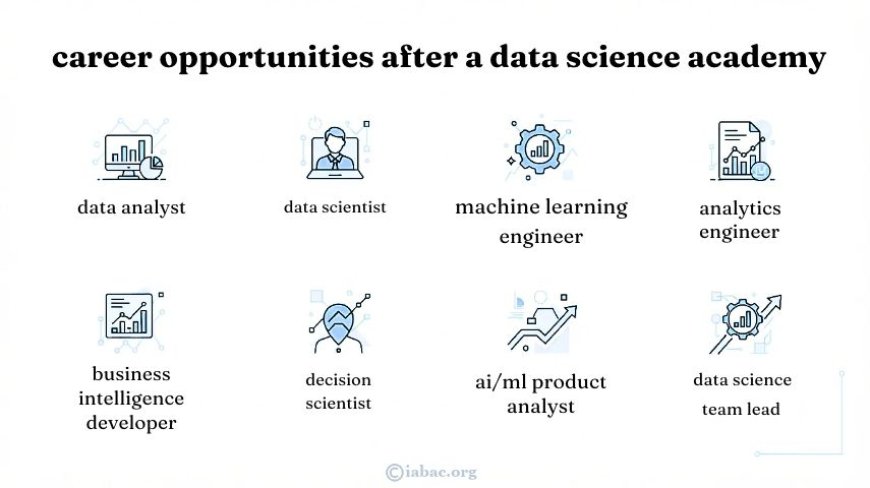
- Data Analyst — reporting, dashboards, explaining what happened in the data
- Data Scientist — building predictive models, running experiments
- Machine Learning Engineer — putting models into production
- Analytics Engineer — building and maintaining data pipelines
- Business Intelligence Developer — building dashboards and reporting tools
- Decision Scientist — analytics built directly into business strategy
- AI/ML Product Analyst — connecting product decisions with applied AI
- Data Science Team Lead — for those completing more advanced tracks
Pay and role expectations vary widely by region, industry, and prior background, so treat specific numbers you find elsewhere carefully unless they come from current, checkable local sources.
12. Academy Program vs. Short Course: A Quick Comparison
|
Factor |
Data Science Short Course |
Full Academy / Certificate Program |
|
Typical length |
A few weeks |
Several months |
|
Depth of material |
One topic or skill |
Full path: foundations to applied projects |
|
Testing |
Often light or none |
Usually a real project plus an exam |
|
Best for |
Testing interest, filling a narrow gap |
Career change, building a full skill set |
|
Employer signal |
Modest |
Stronger, especially with independent |
13. A Simple Learning Path to Follow
- Statistics and Python/SQL basics
- Working with real, messy data and building visuals
- Core machine learning and model evaluation
- Pick a specialization, if your goal calls for one
- Final project, built from something close to a real work problem
- Independent certification exam, checked through a body like IABAC
- Ongoing learning, through real projects, well after the program ends
Frequently Asked Questions
What is a data science academy, exactly?
It's a training organization built around a full, structured path for learning data science, usually covering foundations, applied skills, and a final project, often ending in an independent certificate.
How is a data science academy different from a single online course?
A single course usually teaches one topic. An academy covers a full learning path across multiple stages, with more structure, testing, and usually a recognized certificate at the end.
Is a data science short course enough to get a job?
Usually not on its own, unless you're adding a narrow skill to an existing, related job. For a full career change, a longer certificate program with a real final project carries much more weight.
How long does a certificate program in data science usually take?
Most solid programs take 4 to 9 months of steady part-time work, depending on your starting skill level and how deep the program goes.
Why does it matter if a certification is independent, like IABAC's?
When the group grading you is separate from the group that taught you, there's less risk of an easy pass just to keep a customer happy. That separation gives employers more reason to trust the certificate.
Do I need a degree before joining a data science academy?
No. Most academies are built for people without a data science degree, including career changers from business, marketing, or other technical fields.
Conclusion and Next Steps
A data science academy can genuinely change the direction of your career, but only if you pick one that actually teaches and tests real skill, not just one with a good-looking landing page. The strongest programs give you a clear order to learn in, real projects to build, and a certificate backed by an independent body, like IABAC, that means something to the person reading your resume.
As a next step:
- Get honest about your current skill level and pick a starting point that matches it.
- Decide clearly what you actually need: a short course, a full certificate program, or an executive-level track.
- Shortlist academies where certification is checked independently rather than graded only by the school that taught you.
- Confirm the curriculum covers 2027-relevant tools, including some applied AI content.
- Commit to a realistic timeline, and prioritize a real final project over simply finishing videos.
Picked carefully, a data science academy program is one of the most direct ways to move your career forward this year, whether you're starting from zero or adding new skills to work you're already doing.
Sources Referenced
This article is based on general, widely recognized patterns in how professional certification programs and training academies are structured, as understood in early 2027. Specific statistics, pay figures, and market growth numbers change often, so readers should check current information directly through:
- IABAC's official certification and syllabus pages
- Current labor market reports from national or regional labor statistics offices
- Established professional groups covering data science, analytics, and AI workforce trends
- Job postings and hiring requirements in your specific target industry and region, for the most current, locally relevant signal
Note: This article avoids citing specific numbers that could not be independently checked at the time of writing. For current market size, pay, or growth-rate figures, please check up-to-date, original sources before using them to make a decision.