Is Data Science in Healthcare Transforming the Future of Medicine?
See how data science supports better diagnosis, medical research, patient care, disease prediction, and healthcare decisions through advanced analytics.
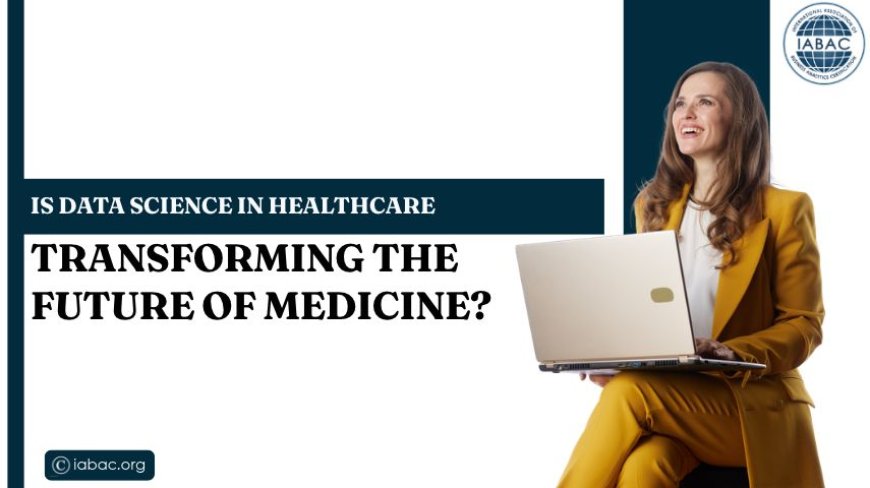
Healthcare is changing as hospitals, research centers, and medical professionals use technology to understand patient information and improve treatment decisions. From identifying early signs of disease to helping researchers develop new medicines, data science is becoming an important part of modern healthcare. Data science in healthcare combines statistics, machine learning, artificial intelligence, and big data analytics to turn medical information into useful insights. These insights can help doctors identify health risks, support clinical decisions, manage hospital resources, and develop treatment plans suited to individual patients. However, using data in healthcare involves more than advanced technology. Medical professionals must also consider patient privacy, information accuracy, ethical practices, and the reliability of automated predictions. So, is data science in healthcare transforming the future of medicine? Understanding its applications, benefits, challenges, and career opportunities provides a clearer answer.
What Is Data Science in Healthcare?
Data science in healthcare refers to the process of collecting, processing, analyzing, and interpreting medical information to support better healthcare decisions. It combines knowledge of statistics, programming, machine learning, and healthcare practices. Hospitals generate information through electronic health records, laboratory tests, medical imaging, prescriptions, patient monitoring devices, and clinical research. Data scientists analyze these different sources to identify patterns that may not be immediately visible to healthcare professionals. For example, a hospital may analyze previous patient records to identify factors associated with readmission after surgery. The findings can help healthcare teams identify patients who may need additional monitoring or follow-up care. Similarly, researchers can analyze genetic information to understand how different patients respond to particular treatments. To understand the Data Science Meaning in healthcare, think of it as using medical information to answer important questions, recognize patterns, and support decisions with evidence.
How Is Data Science Transforming Healthcare?
Data science is influencing several areas of healthcare, from patient diagnosis to medical research and hospital administration.
1. Predictive Analytics and Early Disease Detection
Early identification of health problems can help medical professionals make timely decisions. Predictive analytics uses historical information and statistical models to estimate the likelihood of particular outcomes. Healthcare organizations can analyze patient age, medical history, laboratory results, vital signs, and other relevant information to identify potential health risks.
Applications include:
- Identifying patients who may be at risk of hospital readmission.
- Supporting early warning systems for conditions such as sepsis.
- Estimating the likelihood of complications after surgery.
- Identifying patterns that may indicate an increased risk of chronic diseases.
- Supporting public health teams in monitoring disease outbreaks.
For example, a predictive model may identify changes in a patient's vital signs that require immediate clinical review. The medical team can then assess the situation and decide whether further intervention is necessary. These systems support clinical judgment rather than replace it. Their accuracy depends on the quality of the training data, appropriate validation, and careful implementation.
2. Medical Imaging and Artificial Intelligence
Medical imaging produces large amounts of information that specialists must examine carefully. Data science and deep learning can help analyze these images and highlight patterns that require attention.
Computer vision models can be trained using medical images such as X-rays, CT scans, MRIs, and mammograms.
Common applications include:
- Highlighting suspicious areas in radiology images.
- Supporting the detection of certain tumors.
- Identifying patterns associated with eye diseases.
- Measuring changes in organs or tissues over time.
- Helping specialists prioritize images that require urgent review.
For example, an AI-assisted imaging system may highlight an area of a chest X-ray that needs closer examination. A radiologist can review the highlighted region alongside the patient's history and other clinical findings. Such tools can support medical professionals, but they must be tested across appropriate patient groups and clinical settings before they are relied upon for medical decisions.
3. Personalized Medicine and Patient Care
Patients can respond differently to the same medication or treatment. Personalized medicine aims to account for these differences when selecting appropriate care. Data science helps healthcare researchers analyze information such as genetic variations, medical history, lifestyle factors, and previous treatment responses.
This information can support:
- Identifying patients who may respond to particular medicines.
- Understanding differences in treatment outcomes.
- Assessing potential medication-related risks.
- Supporting treatment planning for certain cancers.
- Studying the relationship between genetics and disease.
For example, genomic analysis can help doctors determine whether a patient has a genetic variation that affects how a particular medication is processed. The result may help clinicians choose a suitable treatment or dosage when supported by established clinical evidence. However, personalized medicine requires careful interpretation, and not every treatment decision can be predicted from genetic or patient data alone.
4. Drug Discovery and Medical Research
Developing a new medicine requires extensive research, testing, and clinical evaluation. Data science can help researchers examine large datasets and identify promising areas for further investigation. Machine learning models can analyze molecular structures, biological pathways, genetic information, and previous research findings.
Researchers may use these methods to:
- Identify potential drug candidates.
- Predict certain molecular properties.
- Study how compounds interact with biological targets.
- Identify existing medicines that may be suitable for further investigation for other conditions.
- Analyze clinical trial results and identify patterns in treatment responses.
For example, a research team may use machine learning to shortlist chemical compounds that could interact with a particular biological target. Laboratory experiments and clinical research are still needed to determine whether those compounds are safe and effective. By helping researchers prioritize promising candidates, data science can support more focused medical research.
5. Hospital Resource Management
Data science is also useful for improving the operational side of healthcare. Hospitals must manage staff schedules, medical equipment, beds, medicines, and patient appointments while maintaining quality of care.
Analytics can help administrators understand demand and allocate resources more effectively.
Common applications include:
- Forecasting emergency department patient volumes.
- Planning staff schedules based on expected demand.
- Monitoring medicine and medical supply inventory.
- Identifying appointment patterns and missed visits.
- Analyzing hospital waiting times.
- Planning bed availability and discharge processes.
For instance, a hospital may analyze historical admission patterns to anticipate periods of higher patient demand. Administrators can use the findings to review staffing plans and resource availability. These improvements can support efficient operations while helping healthcare organizations make better use of their available resources.
What Types of Data Are Used in Healthcare Data Science?
Healthcare data scientists work with different forms of information. Each type requires suitable collection, processing, and analytical methods.
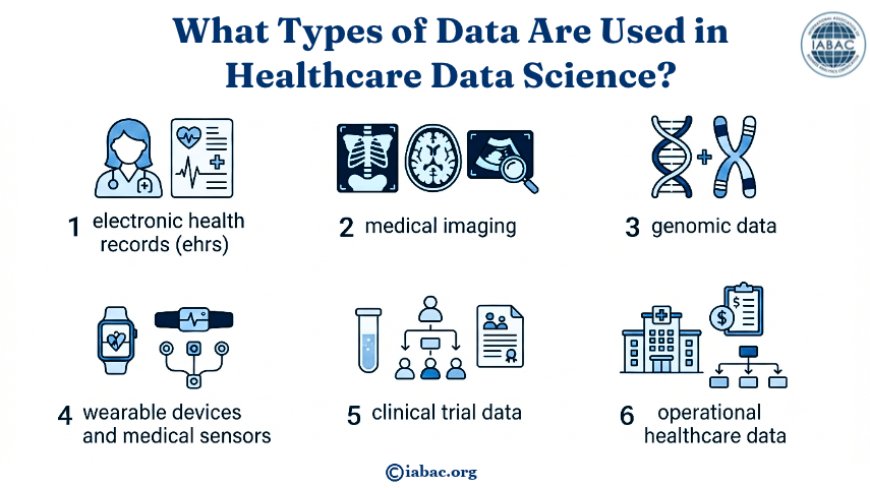
- Electronic health records (EHRs): These contain information such as diagnoses, prescriptions, allergies, laboratory results, and treatment histories.
- Medical imaging: X-rays, CT scans, MRIs, and other images can be analyzed using computer vision techniques.
- Genomic data: DNA sequences and related biological information help researchers study genetic variations and disease mechanisms.
- Wearable devices and medical sensors: Devices may collect information such as heart rate, activity levels, sleep patterns, or glucose measurements.
- Clinical trial data: Researchers analyze participant characteristics, treatment assignments, safety outcomes, and responses to evaluate medical interventions.
- Operational healthcare data: Appointment records, staffing schedules, inventory information, and hospital admissions can help improve administration.
Combining these sources may provide a more complete picture of a healthcare problem. However, combining information from different systems can be difficult because formats, terminology, and data quality often vary.
Which Technologies Are Used in Data Science in Healthcare?
Healthcare data science brings together several technical skills and technologies.
- Programming Languages: Python is widely used for data processing, machine learning, statistical analysis, and visualization. R is another useful language for statistical computing and research. SQL helps professionals retrieve and organize information stored in relational databases.
- Machine Learning: Machine learning models identify patterns in existing data and use those patterns to make predictions or classify information. Applications include risk prediction, medical image analysis, and research support.
- Statistical Analysis: Statistics helps researchers interpret clinical findings, evaluate uncertainty, compare treatment outcomes, and assess whether observed patterns are meaningful.
- Natural Language Processing: Natural language processing (NLP) can extract useful information from clinical notes, medical reports, and other text-based records. These methods can help organize information that is difficult to analyze using conventional database queries.
- Data Visualization: Charts, dashboards, and reports help doctors, researchers, and administrators understand analytical findings. Clear visualizations can make complex information easier to interpret.
- Healthcare Data Standards: Standards such as HL7 and FHIR help healthcare systems exchange information in consistent formats. Their use can improve interoperability, although organizations still need to address differences in terminology, data quality, and system implementation.
What Are the Main Challenges of Data Science in Healthcare?
Although data science offers several opportunities, healthcare organizations must address important challenges before adopting analytical systems.
Patient Privacy and Data Security
Medical records contain sensitive personal information. Organizations must apply suitable access controls, encryption, data minimization, and security procedures. They must also follow the privacy and healthcare regulations that apply in their jurisdiction. For example, HIPAA establishes requirements for protected health information in the United States, while other countries have their own legal frameworks. De-identification can reduce privacy risks, but it does not automatically eliminate every possibility of re-identification.
Incomplete and Inconsistent Data
Medical records may contain missing values, inconsistent terminology, duplicate entries, or information stored in different formats. Poor-quality data can affect model accuracy and lead to misleading conclusions. Healthcare teams must validate and clean information before using it for analysis.
Algorithmic Bias
A model trained on data that does not adequately represent the intended patient population may produce less reliable results for certain groups. For example, a prediction model developed using records from a limited group of hospitals may not perform equally well in hospitals serving different populations. Testing models across relevant groups and monitoring their performance over time can help identify these problems.
Clinical Trust and Accountability
Doctors need to understand the limitations of analytical tools before using their recommendations. Healthcare organizations must establish clear procedures for human review, responsibility, and responding to incorrect predictions. A model should not be treated as reliable simply because it produces an accurate result on a training dataset. Independent evaluation and appropriate clinical validation are necessary.
How to Start a Career in Healthcare Data Science
Healthcare data science can be a suitable career path for people interested in technology, analytical problem-solving, and medical research. Professionals may enter this area through data science, computer science, statistics, biomedical engineering, healthcare analytics, or related backgrounds.
A structured learning plan can help beginners build the required skills.
Step 1: Understand the Introduction to Data Science
Start by learning what data science is and how it helps solve analytical problems. Understand data collection, data cleaning, exploratory analysis, statistics, and basic visualization. A clear introduction to data science provides the foundation for more advanced topics.
Step 2: Learn Programming and Database Skills
Begin with Python and SQL. Practice reading datasets, cleaning missing values, combining tables, and creating visual summaries. R can also be useful, particularly for statistical research and clinical studies.
Step 3: Study Statistics and Machine Learning
Learn probability, descriptive statistics, hypothesis testing, regression, classification, model evaluation, and basic machine learning. Healthcare applications require special attention to false positives, false negatives, uncertainty, and the consequences of incorrect predictions.
Step 4: Understand Healthcare Data
Study the structure of electronic health records, medical terminology, clinical research, patient privacy, and healthcare data standards. You do not necessarily need to be a medical professional to begin learning healthcare analytics, but understanding the context of the data is important.
Step 5: Complete a Data Science Project
A practical data science project helps demonstrate analytical ability.
Possible project ideas include:
- Analyzing hospital appointment attendance using anonymized or synthetic data.
- Building a model to study hospital readmission risk using a suitable public dataset.
- Creating a dashboard that summarizes patient admission patterns.
- Analyzing public health datasets to identify changes over time.
- Comparing machine learning models using an appropriately documented medical dataset.
Projects should explain the problem, the data source, the analytical method, the evaluation process, and the limitations. Avoid publishing identifiable patient information or presenting experimental predictions as medical advice.
Step 6: Follow a Data Science Roadmap
A data science roadmap can help learners progress from basic concepts to advanced applications.
A practical sequence is:
- Programming fundamentals and SQL.
- Statistics and data preparation.
- Exploratory data analysis and visualization.
- Machine learning and model evaluation.
- Healthcare data standards and privacy.
- Domain-focused projects and portfolio development.
- Advanced topics such as NLP, computer vision, or clinical prediction.
The time required depends on previous experience, study time, and the depth of knowledge needed for a particular role.
How Can a Data Science Certification Support Career Development?
A data science certification can help learners demonstrate their knowledge and provide a structured way to assess their skills. When evaluating a certification, consider whether its syllabus covers relevant technical concepts, whether the assessment measures actual understanding, and whether the credential aligns with your career goals.
A useful data science syllabus may include:
- Programming and database fundamentals.
- Data cleaning and exploratory analysis.
- Statistical methods.
- Machine learning principles.
- Data visualization.
- Model evaluation and responsible data use.
- Practical analytical assignments or assessments.
For healthcare-focused roles, additional knowledge of medical data, patient privacy, clinical research, and ethical AI is valuable. IABAC® (International Association of Business Analytics Certifications) is a certification body that provides credentials across areas such as data science, artificial intelligence, and business analytics. Professionals can review the available certifications at IABAC Data Science Certification to identify a credential that matches their current knowledge and professional objectives.
A certification can support professional development, but it does not guarantee employment or replace the practical experience required for specialized healthcare roles.
What Does the Future Hold for Data Science in Healthcare?
The role of data science in healthcare is likely to continue developing as medical organizations improve their data systems and adopt more advanced analytical methods.
Several areas deserve attention.
- AI-assisted clinical decision support: Carefully validated systems may help clinicians interpret complex information and identify findings that need further review.
- Remote patient monitoring: Data from connected medical devices may help healthcare teams monitor selected conditions outside traditional hospital settings.
- Advanced medical imaging: Improved analytical models may support image interpretation, measurement, and prioritization of clinical cases.
- Genomics and precision medicine: Better methods for analyzing biological data may help researchers understand disease mechanisms and treatment responses.
- Healthcare operations: Forecasting and optimization tools may help organizations plan resources and reduce avoidable delays.
Progress will depend on more than technical improvements. Reliable data, appropriate regulation, clinical validation, patient consent where required, and professional oversight will remain important.
Conclusion
Data science in healthcare is changing how medical information is analyzed and used. Predictive analytics, medical imaging, personalized medicine, drug discovery, and hospital resource planning demonstrate how analytical methods can support healthcare professionals. At the same time, patient privacy, data quality, algorithmic bias, and clinical reliability must remain priorities. Technology is most useful when its findings are carefully evaluated and applied by qualified professionals. For aspiring professionals, learning programming, statistics, machine learning, and healthcare data practices can provide a strong foundation. A relevant data science certification and practical project experience can further help demonstrate these skills. As healthcare organizations continue to improve their use of medical information, data science is positioned to play an important role in supporting research, clinical decisions, and more effective healthcare services.