What India's Growing Business Sector Needs to Know About Agentic AI
Learn how Agentic AI can help Indian businesses automate tasks, improve workflows, manage risks, and prepare for smarter business operations in 2027.
Imagine having an employee who can understand a task, prepare a plan, make decisions, use different software tools and complete the work with very little supervision. Now imagine having several such digital assistants working together across different departments. They do not simply wait for instructions at every step. They can understand objectives, respond to changing situations and take action within the permissions given to them.
This is the idea behind Agentic AI.
India's business sector is experiencing significant changes as companies adopt artificial intelligence to improve productivity, customer service, business operations and decision-making. From technology startups in Bengaluru to financial institutions in Mumbai and manufacturing companies in Chennai, businesses are looking for practical ways to use AI beyond basic automation. Traditional AI tools have already changed how people work. Generative AI can prepare reports, answer questions, create content and assist with programming. However, businesses increasingly want systems that can do more than generate responses. They want AI systems that can understand objectives and complete multi-step tasks.
This is where Agentic AI becomes important.
For students and professionals, this development creates new opportunities to learn about AI agents, automation, machine learning and intelligent business systems. For business owners and EdTech companies, it creates an opportunity to prepare their teams and learners for the next stage of artificial intelligence. Understanding Agentic AI today can help individuals make better career decisions and help organisations prepare for the changing requirements of India's growing business sector.
What Is Agentic AI? Understanding the Definition and Meaning
Before understanding its business applications, it is important to understand the basic concept.
Agentic AI refers to artificial intelligence systems that can independently work towards a defined goal by planning tasks, making decisions, using available tools and adjusting their actions based on results.
Unlike conventional AI systems that mainly respond to individual instructions, agentic systems can manage a sequence of connected activities.
For example, consider a customer who contacts an online shopping company because an order has not arrived.
A traditional chatbot might provide the delivery policy or share a tracking link. An AI agent could potentially:
- Understand the customer's complaint.
- Retrieve the relevant order information.
- Check the delivery status.
- Identify whether the shipment is delayed.
- Contact the appropriate service system.
- Suggest an available resolution.
- Update the customer after completing the permitted action.
The important difference is that the system works towards completing a task rather than simply providing an answer.
Agentic AI Meaning in Simple Words
The word agentic relates to the ability to act towards a particular objective.
Therefore, the agentic AI meaning is closely connected to systems that can take goal-oriented actions with a degree of autonomy.
An AI agent usually works through four important capabilities:
- Perception: Understanding information from users, systems or the surrounding environment.
- Reasoning: Analysing the available information and deciding what should happen next.
- Action: Using approved tools, applications or systems to perform tasks.
- Learning and adaptation: Using feedback and previous results to improve subsequent decisions, depending on the system's design.
These capabilities allow agentic artificial intelligence to handle tasks that involve multiple steps and changing requirements. It is important to remember that autonomy does not mean unlimited independence. Businesses must establish permissions, security controls, monitoring and human approval for sensitive activities.
How Is Agentic AI Different from Traditional Artificial Intelligence?
Artificial intelligence has developed through several stages. Earlier systems were primarily designed to perform specific functions, such as recognising patterns, classifying information or making predictions. Generative AI introduced another major change by allowing users to interact with systems through natural language. People can now generate documents, write code, summarise information and create marketing content.
Agentic AI takes this further by connecting reasoning with action.
Consider a marketing department planning a new campaign.
A conventional AI tool might suggest campaign ideas and write promotional content. An agentic system could potentially analyse campaign objectives, review approved customer segments, prepare content, schedule activities and monitor performance through connected applications.
The difference is the ability to coordinate multiple activities towards a common goal.
However, agentic AI is not automatically better for every task. A simple automation system may be more suitable when the process is predictable and requires no complex decision-making.
The right technology depends on the business problem.
Why Is Agentic AI Becoming Important for India's Growing Business Sector?
India has a strong technology ecosystem, a large skilled workforce and businesses operating across sectors that depend on digital services. These conditions create opportunities for agentic artificial intelligence to become part of everyday business operations.
According to the Government of India's February 2026 AI update, 87% of enterprises were actively using AI solutions, based on the NASSCOM AI Adoption Index. This indicates that artificial intelligence is already becoming relevant to Indian businesses rather than remaining limited to technology companies. Another important finding comes from EY's India GCC Pulse Survey 2025. It reported that 58% of India's Global Capability Centres were investing in Agentic AI, with another 29% planning to scale their investments over the following year. These developments show why businesses need professionals who understand how AI agents work and how to implement them responsibly.
1. Banking and Financial Services
Banks and financial institutions manage large amounts of customer information, transactions, documentation and compliance activities.
Agentic AI can support activities such as:
- Reviewing financial documents and extracting relevant information.
- Supporting customer queries and service requests.
- Identifying unusual transaction patterns for further investigation.
- Assisting with loan application processing.
- Coordinating internal compliance workflows.
For example, an AI agent could collect information from an application, check whether required documents are available and send incomplete applications for human review. However, financial approvals, credit decisions and sensitive transactions should remain subject to appropriate human supervision and regulatory controls.
2. Healthcare and Medical Services
Healthcare organisations handle patient appointments, medical records, administrative work and communication between departments.
AI agents can help healthcare providers manage:
- Appointment scheduling and reminders.
- Patient enquiry management.
- Medical document organisation.
- Insurance claim administration.
- Coordination between departments.
For example, an AI agent could receive an appointment request, check available time slots and prepare a booking for confirmation. Medical diagnosis and treatment decisions require qualified healthcare professionals. AI should support their work rather than replace clinical responsibility.
3. E-Commerce and Retail
India's growing online retail sector offers several opportunities for AI-powered business automation.
AI agents can help retailers with inventory monitoring, order tracking, customer support and product recommendations. Imagine an online retailer receiving hundreds of customer enquiries during a festive sale. Instead of depending entirely on manual responses, AI agents could identify common issues, retrieve order information and handle approved requests.
This can help customer service teams spend more time resolving complicated complaints.
4. Manufacturing and Supply Chain
Manufacturing businesses need to coordinate production, raw materials, equipment maintenance and product delivery.
Agentic AI can support these activities by:
- Monitoring inventory levels.
- Identifying potential supply delays.
- Analysing production information.
- Scheduling maintenance alerts.
- Coordinating procurement-related tasks.
For example, when an inventory system identifies that a particular component is running low, an AI agent could review approved supplier information and prepare a purchase request for manager approval.
5. Marketing and Business Development
Marketing teams can also benefit from agentic systems.
AI agents may assist with audience research, campaign planning, customer communication, lead qualification and performance reporting. A marketing agent could collect campaign information, identify changes in engagement and prepare suggestions for improving future activities.
However, brand communication, customer privacy and final campaign decisions still require human review.
How AI Agents Work: A Practical Look at Agentic Systems
Understanding the working process is important for anyone planning to build a career in artificial intelligence.
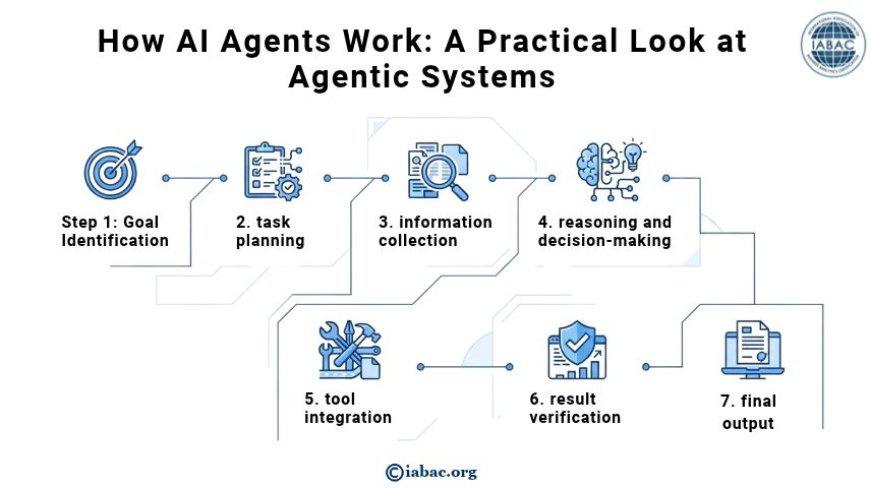
An AI agent does not simply receive information and produce an answer. It follows a sequence of activities to achieve an objective.
A typical agentic AI workflow includes the following stages:
Step 1: Goal Identification
The user or business provides an objective. For example, a company may ask an AI agent to prepare a weekly sales performance report.
Step 2: Task Planning
The agent identifies the activities needed to complete the request. It may need to collect sales information, organise records, calculate performance changes and prepare a report.
Step 3: Information Collection
The agent retrieves relevant information from approved databases, documents or connected applications.
Step 4: Reasoning and Decision-Making
The system analyses the collected information and determines what action should happen next.
Step 5: Tool Integration
The agent uses authorised tools such as APIs, business applications, databases or reporting systems.
Step 6: Result Verification
The system checks whether the requested task has been completed successfully. If something is missing, it may request additional information or seek human assistance.
Step 7: Final Output
The agent prepares the requested report and shares it with the appropriate person.
This process can be repeated across different business activities.
What Are Multi-Agent Systems?
One AI agent can handle a particular task, but complicated business requirements may involve several specialised agents.
This is where multi-agent systems become useful.
For example, an organisation planning a marketing campaign could use:
- A research agent to collect market information.
- A content agent to prepare campaign material.
- A customer analysis agent to organise audience information.
- A reporting agent to monitor campaign results.
These agents can communicate and coordinate through a defined workflow.
The result is a connected system in which different AI agents contribute to a shared objective.
For beginners, understanding this concept is a useful starting point before learning about advanced agent orchestration and enterprise AI development.
Agentic AI Trends That Indian Students and Professionals Should Watch in 2026
Agentic AI is creating new areas of interest for businesses, developers and technology professionals. The following trends are particularly relevant to India's employment and business environment.
1. Growth of AI-Powered Business Operations
Businesses are moving beyond using AI only for content generation and basic customer interactions.
Companies are exploring AI agents that can coordinate multiple activities, retrieve information and complete approved tasks.
This creates opportunities for professionals who understand both AI technology and business processes.
2. Human-AI Collaboration
The future workplace will not necessarily involve humans competing against AI systems.
Instead, employees may work alongside specialised AI agents.
For example, a finance professional could use an AI agent to organise transaction records while concentrating on financial analysis and business recommendations.
This means communication, critical thinking, problem-solving and domain knowledge will remain valuable.
3. Rise of Industry-Specific AI Agents
Businesses increasingly need AI solutions designed for their own requirements.
Healthcare agents, financial research agents, retail assistants, manufacturing agents and education support agents may have different responsibilities and access permissions.
Professionals who understand a particular industry alongside artificial intelligence may have an advantage when developing these solutions.
4. Increased Focus on AI Governance
As AI agents receive access to business applications and information, organisations must establish clear rules.
Important areas include:
- Data privacy and information security.
- Access permissions and identity management.
- Human approval for sensitive decisions.
- Monitoring and audit trails.
- Accuracy and reliability testing.
- Responsible AI practices.
AI governance will become an important part of successful enterprise adoption.
5. Integration of Agentic AI with Existing Business Software
Businesses do not always want to replace their existing applications.
Instead, they want AI agents that can work with approved CRM platforms, ERP systems, databases, customer service applications and reporting tools.
This makes API integration, software architecture and workflow management valuable skills for aspiring AI professionals.
6. Demand for Professionals with Combined AI and Business Skills
Understanding how to write code is useful, but businesses also need people who can identify problems and select suitable AI solutions.
A professional who understands customer service, finance, marketing or supply chain operations can help identify where agentic systems may provide practical value.
This combination of technical knowledge and business understanding is particularly relevant to India's expanding technology and services sectors.
What Skills Do You Need to Build a Career in Agentic AI?
For students and working professionals, learning about agentic artificial intelligence can open up several career pathways. However, becoming an AI professional requires more than knowing how to use AI applications.
A combination of technical knowledge, analytical thinking and business understanding is important.
Here are the major skills worth developing.
1. Programming Knowledge
Programming helps professionals build AI applications and connect different systems.
Important areas include:
- Python programming.
- Basic JavaScript.
- SQL and database management.
- API integration.
- Software development fundamentals.
Python is particularly useful because it supports machine learning, AI development and automation.
2. Generative AI and Large Language Models
Large Language Models (LLMs) are important components of many agentic systems.
Students should understand:
- How LLMs process user instructions.
- Prompt engineering.
- Retrieval-Augmented Generation (RAG).
- Context management.
- Model limitations and hallucinations.
These concepts help developers build AI agents that can understand instructions and work with relevant information.
3. AI Agent Development
This is one of the most important technical areas.
Professionals should learn how to:
- Create individual AI agents.
- Define agent objectives.
- Connect agents with external tools.
- Design multi-agent workflows.
- Manage agent memory and context.
- Evaluate agent performance.
4. Data Science and Machine Learning
AI agents often depend on data to understand situations and make informed recommendations.
Knowledge of data preparation, machine learning, predictive modelling and data analysis can help professionals understand how intelligent systems work.
5. AI Security and Governance
Developers must understand the risks associated with autonomous systems.
Important topics include data protection, access control, responsible AI, output verification and human oversight.
A technically advanced AI agent is not necessarily a reliable business solution. It must also operate within clearly defined boundaries.
Career Opportunities in Agentic AI in India
As organisations investigate AI agents and intelligent automation, several career areas are becoming relevant.
Some possible roles include:
- AI Agent Developer: Designs and develops AI agents that perform specific tasks using language models, APIs and external tools.
- Agentic AI Engineer: Builds systems that combine multiple AI agents, reasoning processes and automated workflows.
- AI Automation Specialist: Identifies repetitive business activities and develops AI-assisted automation solutions.
- Machine Learning Engineer: Develops and maintains machine learning models that support intelligent applications.
- AI Solutions Architect: Plans AI systems, selects suitable technologies and manages integration with existing business infrastructure.
- AI Consultant: Helps organisations identify business problems, evaluate AI opportunities and plan implementation strategies.
- AI Governance Specialist: Supports organisations in establishing responsible AI policies, risk controls and compliance procedures.
Students should understand that these job titles are not guaranteed outcomes of completing a certification. Employers also consider practical experience, technical ability, project work and problem-solving skills.
How Can Students Prepare for Agentic AI Opportunities?
A common mistake among beginners is trying to learn every AI technology at once.
One week, they are learning Python. The next week, they are building a chatbot. Before completing either, they have already started watching videos about autonomous AI agents!
A more organised learning approach can make the process easier.
Here is a suggested progression:
Stage 1: Understand Artificial Intelligence
Begin with AI fundamentals, machine learning concepts, data handling and basic programming.
Stage 2: Learn Generative AI
Understand large language models, prompt engineering, AI applications and the limitations of generated information.
Stage 3: Study AI Agents
Learn how agents understand objectives, plan tasks, interact with tools and manage workflows.
Stage 4: Build Practical Projects
Work on small projects such as customer support agents, document processing assistants and automated reporting systems.
Stage 5: Understand Business Applications
Study how AI agents can support finance, marketing, healthcare, retail, manufacturing and other industries.
Stage 6: Validate Your Knowledge
Consider an appropriate artificial intelligence certification to demonstrate your understanding of AI concepts and professional competencies.
This progression can help beginners build confidence while allowing experienced professionals to develop more specialised knowledge.
Why Artificial Intelligence Certification Matters in the Agentic AI Era
As AI technologies become part of business operations, employers need professionals who can demonstrate their knowledge and understand how to apply it. An artificial intelligence certification can provide structured learning objectives and an assessment of relevant competencies. For students, certification can help establish a foundation in AI concepts. For working professionals, it can support skill development and demonstrate a commitment to professional growth.
When choosing a certification, consider the following:
- Does it cover relevant artificial intelligence concepts?
- Does it assess actual knowledge rather than simply participation?
- Are the learning objectives clearly defined?
- Does it reflect current industry requirements?
- Is the certification issued by a credible certification body?
- Can the knowledge be applied to practical business problems?
How IABAC Supports AI Skills and Professional Development
The International Association of Business Analytics Certifications (IABAC) supports professional competency development through certifications in Artificial Intelligence, Data Science and Business Analytics.
At IABAC.org, individuals can learn about certification pathways that help demonstrate their knowledge and professional capabilities.
The IABAC Artificial Intelligence Certification page provides information about its AI certification offerings.
For individuals interested in developing their professional credentials, IABAC provides an opportunity to understand certification requirements and identify relevant pathways.
It is important to understand that IABAC is a certification body, not a direct training course provider. Individuals can prepare through suitable learning resources and authorised training partners before completing the applicable certification assessment.
Why EdTech Companies and Training Institutes Should Pay Attention to Agentic AI
Agentic AI is not only an opportunity for individual professionals. It also creates an important opportunity for educational organisations. Training institutes, universities, corporate learning departments and EdTech companies need to consider how their programmes can address changing industry requirements. Learners are increasingly interested in understanding technologies that businesses are adopting. Training providers that offer relevant AI learning opportunities can address this interest while helping learners develop skills for emerging professional roles. However, offering AI-related training requires more than adding the words Artificial Intelligence to an existing programme.
Educational organisations should consider:
- Updating learning content to include AI agents and agentic workflows.
- Providing practical exercises based on business requirements.
- Preparing trainers with relevant AI knowledge.
- Introducing AI governance and responsible AI concepts.
- Assessing learners through clearly defined competency requirements.
- Aligning certification preparation with relevant industry expectations.
Become an IABAC Authorised Training Provider
IABAC offers an Authorized Training Provider (ATP) partnership opportunity for eligible training institutes, EdTech companies and educational organisations interested in delivering IABAC certification preparation. Through this partnership, eligible organisations can strengthen their professional certification offerings and provide learners with access to IABAC certification pathways.
Training providers can benefit from:
- Access to relevant IABAC certification programmes.
- An opportunity to expand their AI and Data Science training portfolio.
- Professional certification pathways for their learners.
- An established certification framework.
- Opportunities to serve individuals and organisations seeking professional competency development.
If your organisation is planning to expand its AI training portfolio, visit the IABAC Authorized Training Provider page to understand the partnership requirements. Organisations interested in trainer accreditation can also visit the IABAC Trainer Accreditation Program.
What Challenges Should Indian Businesses Consider Before Adopting Agentic AI?
While agentic AI offers several opportunities, businesses should not assume that every process needs an autonomous system.
Successful implementation requires careful planning.
- Data quality: AI agents depend on accurate and relevant information. Incomplete records can lead to incorrect outputs and poor decisions.
- Security and privacy: Giving AI agents access to business systems creates security responsibilities. Organisations must establish appropriate permissions and safeguards.
- Unreliable outputs: AI agents can misunderstand instructions or produce incorrect information. Verification mechanisms are necessary.
- Integration difficulties: Connecting agents with existing business applications may require technical changes and additional resources.
- Implementation costs: Businesses should evaluate infrastructure, development, maintenance and employee training requirements before investing.
- Human accountability: Organisations must clearly define which activities AI agents can perform independently and which require human approval.
A sensible starting point is to identify one repetitive, low-risk business process, test an AI solution and evaluate its results before expanding implementation.
Agentic AI Could Change How India Works
India's growing business sector is creating new opportunities for artificial intelligence, automation and intelligent business systems. Agentic AI represents an important development because it connects the reasoning capabilities of AI with the ability to perform coordinated tasks. For businesses, it can support customer service, financial administration, marketing, manufacturing and operational activities. For students and professionals, it creates opportunities to develop skills in AI development, machine learning, automation, system integration and AI governance. However, technology alone will not determine who succeeds. People who understand business problems, evaluate AI outputs and use intelligent systems responsibly will remain valuable. The next generation of AI professionals will need more than familiarity with AI tools. They will need the ability to understand how these systems work and where they can provide meaningful value. Whether you are a beginner planning an AI career, a professional looking to develop new competencies, or an EdTech organisation preparing learners for changing industry requirements, now is a suitable time to understand Agentic AI. Build your AI knowledge with IABAC. Visit www.iabac.org to explore artificial intelligence certification opportunities. If you represent a training institute or EdTech company, learn more about becoming an IABAC Authorized Training Provider and bringing professional certification opportunities to your learners.